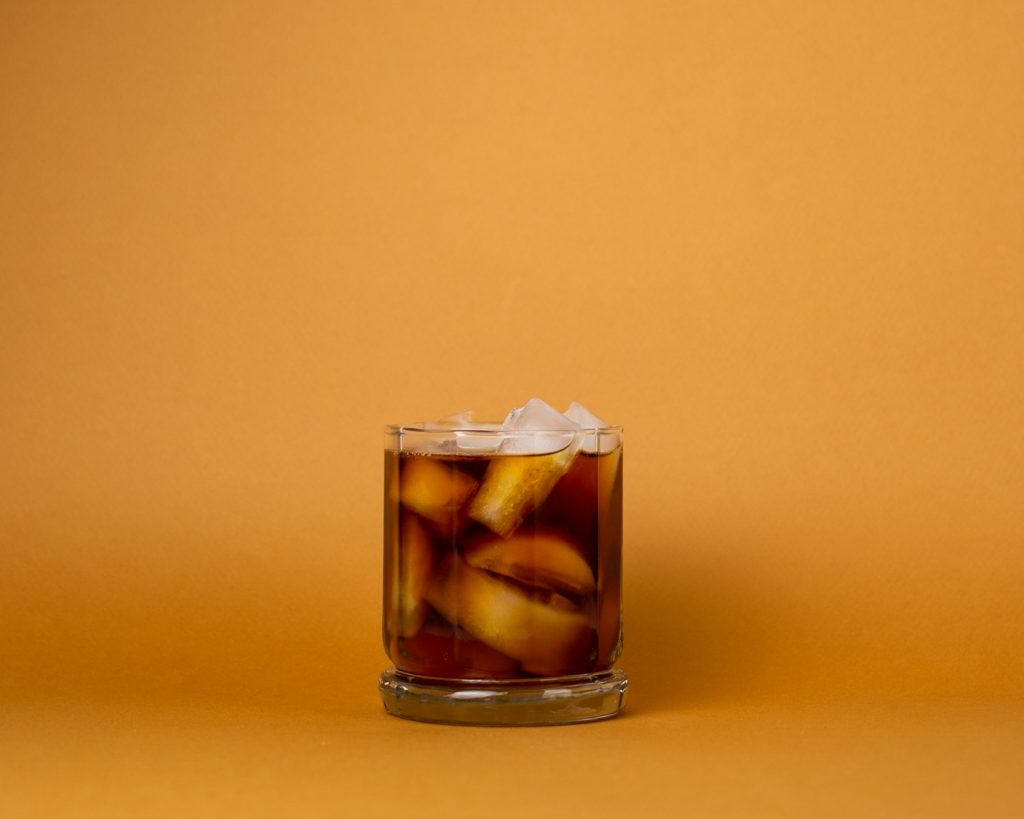
Cold brew is coffee steeped in cold or room-temperature water for hours instead of brewed hot. Nitro cold brew is that same cold brew charged with nitrogen gas, which gives it a fine foam and a creamy head. The nitrogen adds no caffeine: the dose depends on how strong the brew is and how much it was diluted.
Safety: do not assume cold brew is mild. Starbucks lists its 16 fl oz nitro at about 280 mg of caffeine. That is 70% of the 400 milligrams a day the FDA cites for most adults as “an amount not generally associated with negative effects”, and the FDA lists jitters among the signs of too much caffeine. Keep cold brew refrigerated (see “Keep it cold”, below). If you have a heart-rhythm, blood-pressure or anxiety condition, or are pregnant, read the disclaimer below first.
Table of Contents
How much caffeine is too much? What the FDA says
The FDA cites “400 milligrams a day — that’s about two to three 12-fluid-ounce cups of coffee — as an amount not generally associated with negative effects.” It immediately qualifies that: “there is wide variation in both how sensitive people are to the effects of caffeine and how fast they eliminate it from the body”, and “Certain conditions tend to make people more sensitive to caffeine’s effects, as can some medications. If you are concerned about a condition or medication, or if you’re pregnant, trying to become pregnant, or breastfeeding, we recommend talking to your health care provider about whether you need to limit caffeine consumption” (FDA, Spilling the Beans).
Its list of what too much caffeine looks like includes jitters: “increased heart rate, heart palpitations, high blood pressure, insomnia or sleep disruptions, anxiety, jitters, upset stomach, nausea, headache.”
Watch the cup sizes, because this is where dose advice usually falls apart. The FDA’s cup is 12 fluid ounces. A brewing “cup” is 6 fl oz. A large cold brew is often 16 fl oz. Three different cups, one word. Our page on how long coffee bloat lasts works through that ambiguity in detail, and the figures here are consistent with it.
The FDA also declines to give coffee a single caffeine number, and so do we. Its table lists “coffee, regular brewed non-specialty” at 113 to 247 milligrams per 12 fluid ounces and adds: “The amount of caffeine in specific products, and container sizes, can vary.” A drink whose strength is set by the person pouring it has no fixed number.
Concentrate or ready to drink? Why the label sets your caffeine dose
The National Coffee Association is explicit that cold brew has two forms: “The cold brewing process also allows you to make a stronger cold brew concentrate, which is designed to be diluted with water or enjoyed with ice, even as it melts.” Its published cold brew numbers are, by our reading, a concentrate ratio: “Coffee-to-water ratio: 1 gram of coffee to 4-5 grams of water (1:4 to 1:5)”, with “Typically, an approximate 12 hours of contact between coffee and water”, and steep times that “can vary significantly, from as little as a few minutes to 12–18+ hours overnight” (NCA, Cold brew coffee).
- 1:4 to 1:5 by weight is concentrate strength, about four times the coffee per water of our 1:18 reference. The NCA’s steps do not say to dilute it; we would.
- Our house ratio is 1:18 by weight — the Specialty Coffee Association’s home brewer standard specifies “The standard brew ratio of 55 g of coffee per 1.000 kg of 17±3°C water” (SCA Standard 310-2021, Home Coffee Brewers, §7.1.5). That is the drip reference. Method-specific ratios like the NCA’s cold brew concentrate are legitimately different, not contradictions of it.
- Stronger means more coffee, not less. If a diluted concentrate tastes weak, add concentrate or use less water. Do not steep longer and hope.
Practically: brew at 1:4 to 1:5 by weight, then dilute the finished concentrate with water, milk or ice before you drink it. How much you dilute is taste, but it is also your caffeine dial, and it is the single number that decides whether a glass is a modest cup or most of a day’s allowance. A shop-bought bottle should say on the label whether it is a concentrate or ready to drink — if it does not say, treat it as a concentrate until you have tasted it.
Strain it through something that will actually hold coarse grounds; the options and what each does to the cup are in coffee filter types: paper, metal and cloth.
Keep it cold. Wisconsin’s agriculture department treats cold brew made without a heat step as a food that needs time and temperature control for safety and “requires refrigeration” unless a business shows otherwise. A cafe there needs no special safety plan if its cold brew is brewed, held and served at 41°F (5°C) or below and date-marked for no more than seven days (and, if kegged, kept in the keg for 48 hours or less) (Wisconsin fact sheet). That guidance is for retail food businesses, not home kitchens, but it is the clearest published standard we found. The NCA’s home method allows a room-temperature steep; steeping in the fridge fits both.
Is cold brew less acidic?
This has been measured. In a study that brewed the same coffees hot and cold at three roast levels, “Cold brew coffees from each of the three roasts were found to be less acidic than their hot brew counterparts, with mean values differing by 0.20, 0.26, and 0.34 pH units” (Rao, Fuller & Grim, Foods 2020;9(7):902). A fifth to a third of a pH unit is a real, repeatable difference. It is not a large one.
That difference does not make cold brew a remedy for acid reflux. A fraction of a pH unit cannot support a medical claim. If coffee upsets your stomach, the mechanisms are covered, with sources, in why coffee makes you nauseous, and the short version is that it is not purely an acid effect, so switching to cold brew may not fix it.
The same study also undercuts the idea that cold brewing is a caffeine lever: “The caffeine concentrations of all coffees analyzed were comparable regardless of roast level or brewing temperatures”, using 20 g of coffee to 200 mL of water for both. That was one lab study of one Colombian arabica at three roasts, steeped at room temperature for 7 hours or brewed at 100 °C for 6 minutes, and the authors call the caffeine result “consistent with previous studies”. Cold brew’s reputation for being strong probably comes from concentrates and from 16 oz servings, not from the water temperature.
What does nitrogen do to cold brew?
Nitro cold brew is cold brew charged with nitrogen and served through a restricted tap or from a can with a widget. It is also sold as nitro coffee. The reason nitrogen is used rather than carbon dioxide is solubility. NIST’s Chemistry WebBook lists Henry’s law constants in water of about 0.0006 mol/(kg·bar) for nitrogen against about 0.035 mol/(kg·bar) for carbon dioxide — carbon dioxide is roughly fifty times more soluble. So nitrogen does not stay dissolved and does not turn the drink fizzy or sour the way carbonation does; it comes back out as a very fine foam when the pressure drops at the tap. That is the cascade, and that is the creamy head.
What we cannot support is a taste claim. We searched PubMed for a peer-reviewed sensory trial testing nitrogen-infused against still cold brew and did not find one. The closest published work we found, a 2020 sensory survey of 44 commercial cold brews that included nitrogen-infused ones, compared product categories rather than nitrogen against the same brew (McCain-Keefer et al., Journal of Sensory Studies 2020). The sweetness and smoothness claims we found online cite no study. Starbucks says its nitrogen creates “a sweet flavor without sugar”, which is a menu description, not a test. The texture change is real and physical. Whether it makes the coffee taste better is your palate.
Does nitro cold brew have more caffeine?
Nitrogen does not add caffeine. It is a gas. Nitro is made from cold brew, so its caffeine is whatever the underlying cold brew and its dilution give you. A cafe’s nitro may well be stronger than its cold brew, but if so that is a recipe decision, not a property of nitrogen.
Starbucks shows how that works. A chain can publish a figure because it fixes the recipe, and its nutrition pages, read on 6 October 2026, list:
| Starbucks drink | Size | Caffeine | Ingredients listed |
|---|---|---|---|
| Cold Brew | Grande, 16 fl oz | about 205 mg | Brewed coffee, ice |
| Nitro Cold Brew | Grande, 16 fl oz | about 280 mg | Brewed coffee |
The nitro is listed without ice, so the same 16 fl oz cup holds more coffee (our reading of the two ingredient lists). Starbucks marks both caffeine figures as approximate and says its nutrition information “is calculated based on our standard recipes” (Cold Brew, Nitro Cold Brew).
Is nitro cold brew safe?
Properly made and kept, the regulator calls the risk low. Two things to watch. One is caffeine, covered above. The other is how the drink was packaged and kept. In 2017 Death Wish Coffee recalled its canned Nitro Cold Brew after a process authority found that its process could allow botulinum toxin to grow in a low-acid drink sealed in reduced-oxygen packaging; the company reported no illnesses (FDA-posted announcement). Wisconsin’s fact sheet for retail food businesses says that “In kegged cold brew, mishandled product could cause botulism to grow and produce toxin”, and that kegged cold brew, or cold brew packaged by swapping the oxygen for another gas “such as nitrogen”, needs a HACCP plan and a variance if it is held more than 48 hours. It also says that “if prepared, stored, and served properly, the risks of illness after consuming cold brew are low.”
Cold brew or nitro: which should you choose?
| Cold brew | Nitro cold brew | |
|---|---|---|
| What it is | Coffee steeped in cold or room-temperature water | Cold brew infused with nitrogen under pressure |
| Contact time | A few minutes to 12–18+ hours (NCA); about 12 hours typical | Same, plus the infusion |
| Texture | Plain liquid | Fine foam, creamy head, no dairy needed |
| Acidity | 0.20–0.34 pH units less acidic than the same coffee brewed hot (one study) | Same as its cold brew base |
| Caffeine | Set by the brew ratio and how much you dilute it, not by the method. Nitrogen adds none. | |
| Equipment | A jar and a filter | Pressurised keg and tap, or canned |
Pick cold brew if you want to make it at home cheaply and control the strength yourself. Pick nitro if you like the texture and are buying it out.
Roast level is a smaller lever here than people expect — the Rao study found caffeine comparable across roasts as well as across temperatures — but it does change the flavour, and coffee roast levels covers what the roast actually decides. If you are still working out how these drinks differ from milk-based ones, see the difference between coffee and a latte.
Disclaimer: This page is general information, not medical advice. The FDA’s 400 mg figure is population-level guidance for healthy adults, not a safe limit for any individual, and it is a daily total across all sources, not a per-drink allowance. If you are pregnant, trying to become pregnant, breastfeeding, taking prescription medication, or living with a heart-rhythm, blood-pressure, anxiety or sleep condition, ask your own clinician or pharmacist about caffeine. In the United States, Poison Control is 1-800-222-1222, and its own instruction is that “If the individual collapses, has a seizure, has trouble breathing or can’t be awakened: Call 911 now!”
Corrections to earlier versions of this page
- An earlier version’s caffeine table gave “200-300 mg” per 16 oz for cold brew and “180-280 mg” for nitro, with no source, and said cold brew “typically gives a mild energy lift without jitters”. The figures were removed rather than re-sourced, and the framing was wrong: 300 mg is three quarters of the FDA’s 400 mg daily figure, and the FDA lists jitters among the signs of too much caffeine.
- An earlier version gave a recipe by volume, “Mix four cups of water with one cup of grounds”, and said “Now your cold brew is ready to enjoy.” That is a concentrate, and this site’s ratios are by weight.
- An earlier version said cold brew’s “low acidity is gentle on the stomach, perfect if acid reflux is a concern.” That medical claim cited nothing, and the measured pH difference does not support it.
- An earlier version said nitrogen “enhances the coffee’s natural flavors, making nitro richer than standard cold brew” and makes the drink “slightly sweeter”. We found no sensory trial in PubMed behind either claim.
- An earlier version took three positions on nitro’s caffeine: lower than cold brew in a table, “usually have similar caffeine levels” in one sentence, and “Nitro coffee usually has more caffeine than regular brews, providing a strong energy boost” in another. Nitrogen adds none; the cold brew and its dilution set the dose.
- An earlier version had a table of cafe prices and equipment costs with no source and no date. It was removed; we did not survey prices.