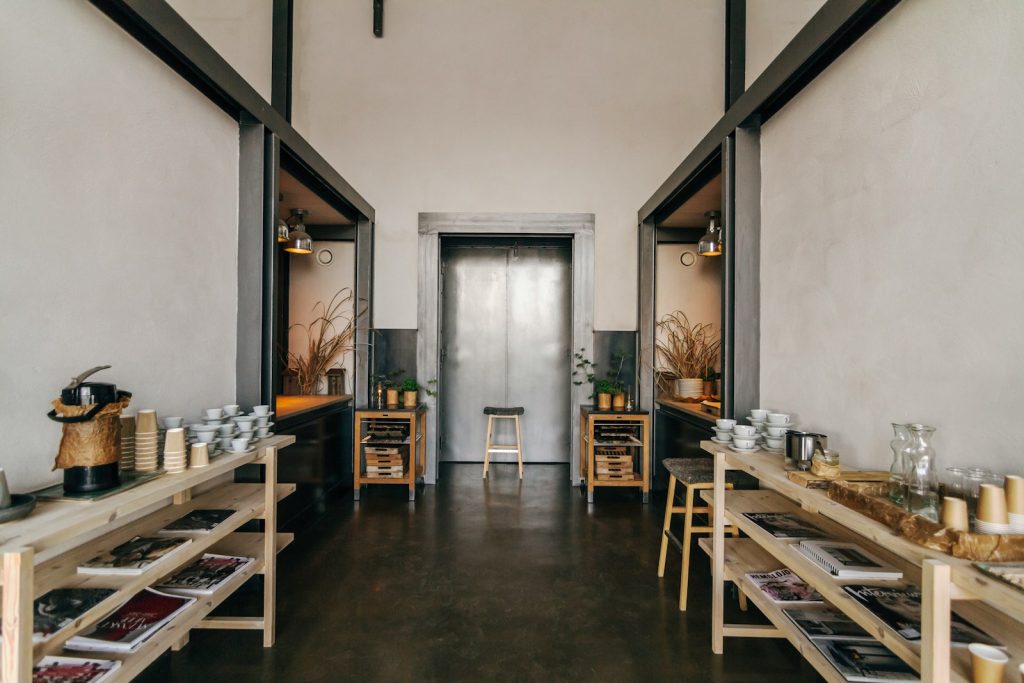
To set up a home coffee station, put it where you have water, power and a bin within arm’s reach, and lay the gear out in the order you use it: beans, scale, grinder, brewer, cup, waste. Keep beans in an opaque, airtight container away from light and heat, such as an oven, a dishwasher or a sunny window.
A coffee station is a layout problem, not a shopping problem. What to actually buy is a separate question, and it is answered on our page about brewing tools and accessories, which carries the equipment case, the sources, and the plain statement that none of it has been tested by us. This page does not repeat that list.
Table of Contents
Where should you set up a coffee station?
Four constraints decide the location, and they beat aesthetics every time because you will be using this half-awake.
- Water. Filling a kettle at the sink and carrying it across a room is the step people quietly stop doing. If the station cannot be near a tap, it needs a jug that lives there permanently.
- Power, with enough sockets for everything at once. A grinder and a kettle sharing one outlet through an adaptor is how a station turns into a cupboard.
- A bin or a knock-box within reach. Wet grounds and used filters are the actual daily output of a coffee station. If disposing of them means walking, the counter stays dirty.
- Somewhere that does not get warm or bright. This is the one that gets ignored, and it is the one that costs you flavour. More on it below.
Two things worth checking before you commit: whether a cupboard door or the dishwasher door swings into the space, and whether the counter is deep enough that a kettle handle is not overhanging the edge. Both are obvious and both get discovered after the shelf is up.
Lay it out in the order you touch it
The single change that makes a station feel good to use is arranging it as a line rather than a display. The sequence of a brew is fixed, so the counter should match it, left to right or right to left depending on which hand you use:
beans → scale → grinder → brewer → cup → waste
Everything you use every single morning sits on the counter in that order. Everything you use weekly or less — spare filters, the second brewer, the milk frother you use at weekends — goes in the cupboard or the drawer underneath. The test is not whether the station looks complete; it is whether you can make a cup without moving anything that is not part of making a cup.
Two layout details that repay the thought: leave a clear landing space beside the grinder large enough to set down a full mug and the bag at the same time, and put the mugs where you can reach them without crossing over the kettle. Reaching across a hot kettle is an easy way to knock a cup over or burn a hand.
Storage: the part that changes how the coffee tastes
This is the only section on this page where the layout decision has a documented effect on the cup, so it is the one worth getting right. The National Coffee Association names the four things to keep away from beans: “air, moisture, heat, and light (aka their greatest enemies)” (NCA, coffee storage and shelf life).
That rules out most of what a coffee station is usually decorated with. Clear glass jars on an open shelf are the classic mistake, and the NCA is direct about it: “Use aesthetically pleasing jars of beans as décor only!” If the jar is see-through and on display, it is a jar for looking at, not for the coffee you intend to drink.
Location matters for the same reason. The NCA’s guidance is to avoid warm spots: “Avoid cabinets near the oven or dishwasher, as well as any areas that get strong afternoon sun—all can get too warm.” A coffee station on a sunny windowsill above a dishwasher is architecturally charming and is the worst place in the kitchen for the beans.
Buy in quantities you will finish, because the freshness window is shorter than most people assume. The NCA publishes this chart:
| Type of coffee | Retains freshness |
|---|---|
| Roasted coffee beans (room temperature) | 1–3 weeks |
| Roasted coffee beans (refrigerated) | 2 weeks |
| Roasted coffee beans (frozen) | 3–4 months |
| Ground coffee (room temperature) | 1–2 weeks |
Which is also the argument for a grinder living on the station rather than a bag of pre-ground: the NCA’s advice is to “grind the amount you need immediately before brewing”. On the same chart, ground coffee at room temperature keeps for 1–2 weeks, against up to 3 for whole beans.
If your beans arrive visibly glossy, that is a property of the roast rather than of your storage, and why some coffee beans are oily covers what it does and does not tell you. Either way, those oils are the reason a station needs wiping down: coffee oil goes rancid on burrs, baskets and shelves, and it is a flavour you will taste before you work out where it is coming from.
Minimalist coffee setups for small spaces and shared kitchens
If there is no counter to give up, the station becomes an object rather than a place. Three arrangements that work within the constraints above:
- A tray. Everything for one brew lives on a tray that comes out and goes back. It keeps the sequence intact, it makes cleaning up a single motion, and it survives a shared kitchen where the counter is not yours.
- A rolling cart. The one arrangement that solves the water problem without plumbing: wheel it to the sink, wheel it back. Keep the beans on the lowest shelf, which is the coolest and the darkest.
- Vertical, not horizontal. Mugs on hooks, filters in a wall pocket, the scale standing on its edge in a drawer. Counter depth is the scarce resource; wall is usually free.
If the honest answer is that you do not want a station at all, a pod machine collapses the whole layout into one object and fixes the grind, dose and temperature for you. The trade-offs are set out on types of coffee pods, and it is a real choice rather than a lesser one.
Waste, water and upkeep
The daily jobs are short if the station is arranged for them: rinse the brewer, empty the grounds, wipe the counter. The weekly job is the grinder, which needs the burrs brushed out because old grounds and oil sit in them. The occasional job is descaling anything that heats water, on the schedule and with the agent that your machine’s manual specifies — this depends on your water and your machine, not on a rule of thumb.
Spent grounds do not have to go straight in the bin, and neither do beans that have gone past the window in the chart above: what to do with old coffee beans covers the uses that actually work. And once the station is running, the thing worth doing next is learning to taste what comes out of it — coffee flavor profiles and tasting is the method, with the standards it comes from.
Corrections to earlier versions of this page
- It contradicted the NCA chart printed on this page. An earlier version said “Note that refrigeration is worse than the counter, not better.” and that ground coffee “holds its freshness for a window measured in days rather than weeks”. The chart gives 2 weeks refrigerated against 1–3 weeks at room temperature, and 1–2 weeks for ground coffee; both sentences were corrected.
- A burn statistic with no source. An earlier version said “Almost every burn and every knocked-over cup happens in a crossing motion over something hot.” No source was given, so the claim was softened.
- It quoted prices and named brands with nothing behind either. A machine comparison table gave price bands of “$20 – $150”, “$100 – $500”, “$30 – $200” and “$15 – $50”; an accessory checklist gave an “Average Cost” and a column of “Recommended Brands” for grinders, frothers, scales and filters. Nothing here was bought, priced, or compared. This page now quotes no prices and recommends no brands, and the ones it used to name were not recommendations, they were filler.
- It invented tasting notes for four coffee species. A “Coffee Bean Flavor Profile Table” assigned Arabica “Fruity, Sweet”, Robusta “Bold, Nutty”, Liberica “Floral, Woody” and Excelsa “Tart, Fruity”, each with a “Recommended Roast Level”. No source, no tasting, and no business being on a page about where to put a kettle. It has been deleted. The species themselves are covered properly on Arabica, Robusta, Liberica and Excelsa.
- It told you to run vinegar through your coffee maker every month. No source was given, and the interval is not a general fact: descaling frequency depends on your water hardness, and the agent depends on what your machine’s manufacturer specifies. Follow the manual that came with the machine. The unsourced monthly-vinegar instruction has been removed.
- A link existed only to be a link. The opening section ended “If you’re curious about creating unique blends, check out coffee wine recipes for a creative twist“. Fermenting coffee into wine has nothing to do with organising a kitchen counter. The sentence and its link are gone. A second sentence, “Knowing the difference between coffee and latte can also boost your brewing skills“, was a dangling prompt that did not even link anywhere.
- Three more tables and a block of FAQ markup were padding. A brewing-style comparison duplicated pages that own the topic, a “styles” table sorted decor into minimalist, rustic and modern, and a search-engine FAQ block restated the article back at itself. All removed.