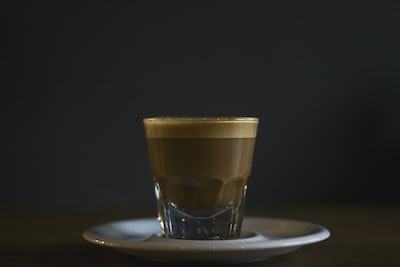
A long black is hot water in the cup first, then a double shot of espresso poured in on top of it. That order is the entire drink. An americano is the same two ingredients in the opposite order — espresso first, hot water poured over it — and pouring the espresso into the water is what leaves the crema sitting on the surface instead of being broken up by the incoming stream. Levent Doganay, quoted by Perfect Daily Grind, describes the Australian and New Zealand build as “pouring a double shot of espresso or ristretto over 100 to 120ml of hot water from the espresso machine.”
Correction: this page has been shipping a broken template placeholder. An earlier version ended its brewing section with the sentence “More detailed guidelines for brewing can be found here”, where “here” was linked to http://your_link_here — an unfilled placeholder from whatever template the page was built from, live on the site and clickable. It is gone. Two other things went with it, and they are listed at the bottom of this page.
Table of Contents
The order of pouring, and why it is not a technicality
Perfect Daily Grind sets the two builds side by side in a single list:
- “To make an americano, baristas pour hot water over espresso”
- “For a long black the opposite is true – so baristas add espresso to hot water”
- “This helps the drink to retain more crema, more than it usually would for an americano”
Crema is not decoration that happens to survive. It is part of what an espresso is expected to arrive with: the World Barista Championship’s official rules state that “Crema should be present when espresso is served, with no break in coverage” (2025 WBC Official Rules and Regulations, §3.1). Dropping a stream of hot water through it disperses it; floating the espresso onto still water does not.
Doganay adds one detail that is easy to miss and costs nothing to follow: he “recommends using water that is heated to around 70°C”, because “If the water is too hot when the espresso is poured over, the crema will dissipate more quickly.” That is his recommendation rather than a published standard, and it is not a brewing temperature — the espresso itself is already brewed. Brew water for the coffee is a separate number with a separate source, covered on our page on the best temperature for coffee brewing. The WBC sets its competition machines to the same range, “between 90.5-96 degrees Celsius (195-205 degrees Fahrenheit)”.
Making one
- Warm the cup, then empty it.
- Put the hot water in first — 100 to 120 ml, per the figure above.
- Pull a double shot of espresso, or a double ristretto if you want it heavier.
- Pour the espresso gently onto the surface of the water. Do not stir.
On proportions: the WBC defines espresso as “a beverage (around 1 fl. oz. / 30 ml)”, so a double shot is roughly 60 ml. Against 120 ml of water that works out at one part espresso to two parts water; against 100 ml it is a little stronger than that. So the “one-third espresso, two-thirds water” description an earlier version of this page gave is a reasonable reading of the published figures, and it has been kept — with the arithmetic shown rather than asserted.
Long black or americano
| Long black | Americano | |
|---|---|---|
| Order | Water in the cup, espresso poured on top | Espresso in the cup, water poured on top |
| Crema | Largely retained as a surface layer | Broken up by the incoming water |
| Water volume | 100–120 ml for a double shot (Doganay, via PDG) | “Typically, baristas also prepare a long black with less water than an americano” |
| Where you will see the name | Australia and New Zealand, and specialty menus elsewhere | Almost everywhere |
One thing a long black is not is a lungo. Perfect Daily Grind is explicit: “It should not be mistaken for a lungo, which is an espresso shot extracted with more water than usual.” A lungo changes the extraction; a long black changes only what the finished shot is poured into.
The Australia and New Zealand story, checked
The regional association holds up. The origin story does not, and this page no longer tells it. An earlier version stated that the long black “emerged during the mid-20th century as the local coffee culture evolved” in Australia and New Zealand, and that it was “crafted for a palate that appreciated stronger coffee notes” — a date and a motive, neither with a source.
What can be supported is narrower. Perfect Daily Grind, reporting from the region, says only that “The long black is a popular coffee shop drink in Australia and New Zealand” and that “Outside of Australia and New Zealand, the drink is usually on café menus under a different name.” That is a statement about where the term is used, not about when or by whom the drink was invented. We looked for a dictionary, historical or trade-body source that dates it and did not find one; Wikipedia’s article carries the mid-century claim, but its own citations for it are two coffee retailer and review blogs, which is not a source we will pass on as history.
This is a familiar shape in Australasian coffee. The flat white’s origin is contested between the two countries in the same unresolved way — Perfect Daily Grind quotes one professional saying “I wouldn’t be able to say whether the flat white originated in Australia or New Zealand… It’s a debate that will likely go back and forth for a long time.” Drinks that grew out of café practice rather than out of a written recipe tend not to leave a paper trail.
Other corrections to an earlier version of this page
- A caffeine figure with nothing behind it. The page’s FAQ stated that “a typical long black has approximately 120 mg of caffeine”. No source, and the number cannot be typical of anything — caffeine in the cup is set by the dose of coffee and how it was extracted, not by the drink’s name. This page prints no caffeine figure. For how wide the real spread is, and the FDA’s own numbers, see what food group coffee is.
- Health claims borrowed from a third-party listicle. The page said a long black “can contribute to a healthy heart and may lower the risk of certain types of cancers”, linked to a general-interest health site. Those are claims about coffee, not about this drink, and they do not belong on a page explaining a pouring order. On the cancer half specifically: when the International Agency for Research on Cancer reviewed the evidence it found “no conclusive evidence for a carcinogenic effect of drinking coffee” and classified coffee as Group 3, not classifiable — which is not the same thing as coffee lowering anyone’s risk. That evaluation, and the finding about drinking anything above 65 °C, is covered on is coffee bad for a sore throat.
- An FAQ block and a duplicated pull-quote. The same sentence about “lengthening of the shot” appeared twice, once as body text and once as a block quote directly beneath it. The FAQ repeated what the body already said. Both removed.
Nobody at this site has pulled a long black to a scale and a stopwatch, so there are no tasting notes here and no timings of our own. If you want the same espresso base taken in the opposite direction — with milk rather than water — start at the difference between coffee and a latte. If you are drinking it black because milk gives you trouble, why almond milk curdles in coffee covers that.