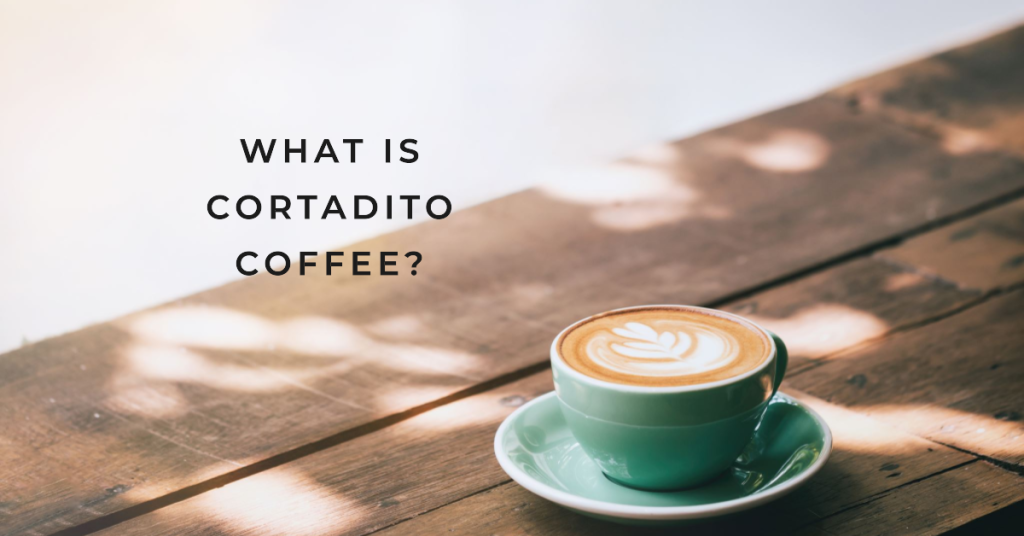
A cortadito is a small Cuban coffee: a shot of sweetened Cuban espresso (café cubano, or cafecito) “cut” with steamed milk. The sugar goes into the coffee before the milk does, which sets it apart from a Spanish cortado. The amount of milk runs from a splash to about half the drink.
Table of Contents
What is a cortadito coffee?
The descriptions we cite agree on the build: Cuban coffee first, already sweet, then milk added to it. Perfect Daily Grind, reporting David McLennan, founder and co-owner of XO Espresso Bar in Miami, glosses the cortadito as “a cubano topped with steamed milk”. The Greater Miami visitor bureau lists it as one of four classic ways to order Cuban coffee, alongside the cafecito, the café con leche and the colada: “The same as a cafecito, but with just a splash of steamed milk, served in a shot glass-sized cup”.
The amount of milk is where descriptions part ways. The bureau says “just a splash” and Perfect Daily Grind gives no amount. Others are more specific:
- OnCuba News, writing in Spanish, says the ventanitas serve “el cortadito, con una pizca de leche” (the cortadito, with a pinch of milk; our translation), and a café con leche with a greater proportion of milk.
- Barista Magazine’s guide to the café cubano says the defining characteristic of the cortado, “the same in Miami as it is in other locales”, is “an equal balance of milk and espresso”.
- Wikipedia’s article on Cuban espresso says the ratio “can be between 50/50 and 75/25 espresso and milk”.
The kind of milk varies too. Several of these descriptions say steamed milk, but El Diario NY, writing in Spanish, describes the cortadito as Cuban coffee “mezclado con leche evaporada” (mixed with evaporated milk; our translation), and Perfect Daily Grind’s explainer on the cortado mentions “replacing the milk with evaporated milk for a treat or in place of dessert” as an option. We couldn’t find a standard for the cortadito from the Specialty Coffee Association or the International Coffee Organization, so treat any single ratio you’re given as one café’s house style, not a rule.
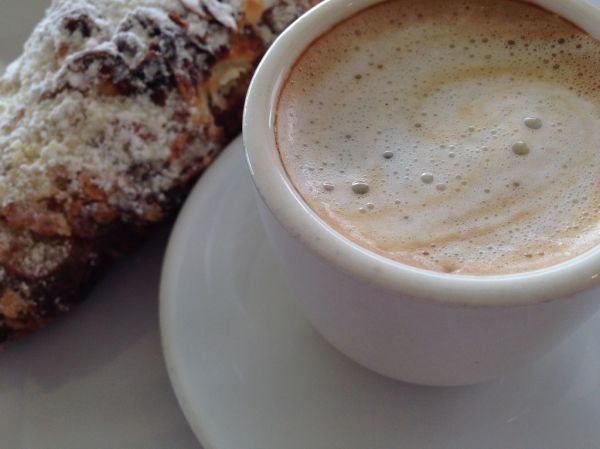
What does cortadito mean?
Cortadito is the diminutive of cortado, the Spanish word for “cut”. Wiktionary derives it from cortado plus the diminutive ending -ito, and divides it cor-ta-di-to. Perfect Daily Grind translates the Cuban drink’s name as “little cut”, and Barista Magazine says it means “little cortado”. The cutting is done by the milk: Perfect Daily Grind says the term cortado “refers to the milk cutting through the intensity of the espresso”.
Cortadito vs cortado, colada and café cubano: what is the difference?
The table sets the cortadito beside the other Cuban coffee orders and the Spanish cortado it is named after. Where sources disagree, the cell says so. For the whole Cuban coffee menu rather than this one drink, start at the four types of Cuban coffee.
| Drink | What it is | Milk | Cup |
|---|---|---|---|
| Café cubano (cafecito) | Sweetened Cuban espresso: sugar is beaten with the first drops of coffee into a foam called espumita | None | A “tacita”, a tiny cup |
| Cortadito | A cafecito “cut” with steamed milk | From a splash to about half the drink, depending on the source | A shot glass-sized cup |
| Colada | Several shots of café cubano made for sharing: 3 to 6 in some descriptions, 4 to 6 in others | None | A larger, usually Styrofoam cup, with small plastic cups for sharing |
| Café con leche | Café cubano with more milk than a cortadito; the traditional Cuban breakfast drink | A greater share than in a cortadito | One cup, or the coffee and hot milk in two cups |
| Cortado (Spain) | Espresso cut with milk; not pre-sweetened | From very little milk to equal parts, depending on the source | A small glass |
At the milk-led end of the menu is the café con leche. OnCuba News says it has a greater proportion of milk than the cortadito, and Barista Magazine calls it “the equivalent of a latte”. For how a latte differs from ordinary coffee, see our page on the difference between coffee and a latte.
Colada vs cortadito
Cortadito vs colada comes down to size and who the drink is for. A cortadito is one small cup, which the visitor bureau puts in a “shot glass-sized cup”. A colada is made for sharing. Perfect Daily Grind describes “three to six cubano shots added to a larger Styrofoam cup which is then shared among multiple people”, and the visitor bureau “four-to-six espresso shots meant for sharing with family and friends”. In both descriptions a colada is shots of Cuban coffee and nothing else, so unlike a cortadito it has no milk. Neither has a fixed size, and our page on Cuban coffee traditions covers the range of shot counts. Ventanitas, the walk-up windows of Cuban cafés, sell cortaditos and coladas alike: OnCuba News lists the cortadito among what they serve, and Barista Magazine describes ordering a colada through one.
Cortadito vs cortado
Both are espresso cut with milk, and the name is the same word with a diminutive ending. What sets the Cuban drink apart is the sugar. In the cortadito section of its guide to the café cubano, Barista Magazine says “the sweetness and technique used to whip the first few drops of espresso into a sugary foam” make the Cuban drink “dissimilar to the cortados that have recently exploded in popularity throughout the rest of the world”, and Wikipedia describes the cortadito as “similar to a cortado served in other Latin countries, but pre-sweetened”.
The amount of milk doesn’t separate them reliably. The Real Academia Española’s dictionary defines café cortado as “café con muy poca leche” (coffee with very little milk; our translation). Perfect Daily Grind says a cortado traditionally has “a 1:1 milk to espresso ratio”, and quotes a Barcelona roaster, Nino Tusell, who says it “could be a ratio of 1:1 or 1:0.5, [with] less milk than coffee most of the time”. The dependable difference is the sweetened coffee underneath, not the milk.
Why is a cortadito sweet?
Because the sugar goes into the coffee, not the milk. Perfect Daily Grind describes Martin Mayorga, founder of Mayorga Organics, building the base drink this way: he “first adds plenty of sugar to a small cup”, brews “a concentrated amount of coffee in a moka pot”, then “adds the first few drops of coffee to the cup, whipping it with the sugar to form a kind of ‘faux crema’ called espumita”. The rest of the coffee goes into a separate cup and the espumita is spooned over it. The same article says demerara or natural brown sugar is often used. A cortadito is that sweet coffee with milk added, and the visitor bureau’s summary is blunt: “Cuban coffee comes sweetened”.
If you copy that method, do not take the first drops from a pot that is still brewing. A moka pot builds pressure while it sits on a heat source. Bialetti’s manual for the Moka Express says the pot “develops pressure inside” and that not following its instructions “may cause the risk of burn or the coffee maker burst”. It also says “During use, close the lid” and “After use, allow the coffee maker to cool down before opening it.” The manual doesn’t mention taking coffee mid-brew, so that conclusion is our reading of the hazard, not a manufacturer rule. The recipe below waits for the pot to finish.
If you’d rather add your own sugar, the visitor bureau says to order it “sin azúcar” (without sugar) and add your own, while warning that this “definitely won’t give the same effect”.
What coffee goes into a cortadito?
A dark roast. Perfect Daily Grind puts it this way: “The cubano should be made with a dark roast to bring out the sweetness and intensity in a coffee.” Barista Magazine says the usual coffee is a dark, Italian-style roast brewed in a moka pot, in brands such as Pilon, Bustelo and La Llave. Italian roast is a roaster’s label, not a standard: see our page on Italian roast vs French roast, and our page on roast levels for what dark roasting does to a coffee. On the bean itself, Perfect Daily Grind reports Mayorga saying that “historically, the cubano has been made with a Brazilian robusta or another inexpensive coffee”. Our pages on robusta and Brazilian coffee cover those beans.
Is a cortadito Cuban? Where the drink comes from
Yes, as a Cuban coffee order. Perfect Daily Grind’s cortado explainer says the Cuban cortadito is “popular in Cuba and Cuban immigrant communities”, and the visitor bureau lists it among the classic ways to order Cuban coffee in Miami. The name comes from the Spanish cortado. Barista Magazine’s history of the cortado tells it as a Spanish drink that spread to Cuba under Spanish rule, and says: “By the mid-20th century, the adapted cortadito was a staple of Cuban coffee culture.” That is one magazine’s account, and Perfect Daily Grind says “Not much is known about the cortado’s origins, apart from that it comes from Spain’s Basque Country”.
In Miami, the visitor bureau dates Cuban coffee culture to the 1950s, when the first wave of Cuban immigrants arrived in South Florida and began opening ventanitas (“little windows”) where you can order Cuban coffee to go. We couldn’t find a source that says who first made a cortadito, or when.
How do you make a cortadito at home?
We couldn’t find a standard recipe, and this page has no first-hand timings, measurements or tasting notes. What follows is the method the sources describe, adapted so that nothing is taken from the pot while it brews. Our page on the four types of Cuban coffee has the moka-pot steps, with Bialetti’s own instructions.
- Brew a concentrated, dark-roast coffee. Perfect Daily Grind says the shot “can be made with an espresso machine” but that “traditionally the drink is prepared using a moka pot”. If your method lets you set the water temperature, our page on the best temperature for French press coffee gives the range with its source.
- Let the pot finish, then take it off the heat. Don’t lift the lid or pour anything out while it’s brewing. Put the sugar in a small cup, pour a small splash of the finished coffee onto it and beat it into a creamy foam: the espumita. Pour the rest of the coffee into the serving cup and spoon the foam over it, as Perfect Daily Grind describes. We haven’t compared this foam with one made from the first drops, so we can’t say the two come out the same.
- Add steamed or heated milk, a little at a time. Start with a splash, taste, and stop wherever you like: the descriptions above run from a splash to about half the drink.
Variations exist. Perfect Daily Grind’s cortado explainer mentions replacing the milk with evaporated milk “for a treat or in place of dessert”, and in Miami New Times JennyLee Molina, one of two Cuban coffee experts the paper interviewed in 2014, describes one restaurant’s “cortadito especial” as “like a colada, but with splashes of evaporated milk and condensed milk, topped with powdered cinnamon”. Both present these as special versions.
How much caffeine is in a cortadito?
We couldn’t find a published caffeine measurement for a cortadito, and the drink has no standard size, so we give no figure for the cup. For scale, the USDA’s FoodData Central entry for restaurant-prepared espresso lists 212 mg of caffeine per 100 g and gives one fluid ounce as 29.6 g, which works out to about 63 mg per fluid ounce (our arithmetic). That entry rests on two data points, last updated in 1996. A café cubano from a moka pot or another machine may differ, and robusta, one of the coffees Perfect Daily Grind says the cubano has historically been made with, is listed by the National Coffee Association as containing “50–60% more caffeine than arabica”. Treat 63 mg as a yardstick, not a measurement of a cortadito.
For most adults, the FDA has cited 400 milligrams a day as an amount not generally associated with negative effects, and says there is wide variation in how sensitive people are to caffeine and how fast they eliminate it. This is general information, not medical advice. The FDA recommends talking to your health care provider if you are pregnant, trying to become pregnant or breastfeeding, or if you are concerned about a condition or a medication.
Corrections to earlier versions of this page
- The milk ratio. An earlier version told readers: “Aim for a 1:1 ratio of coffee to milk.” That was wrong as a rule: no standard fixes the proportion. The version before this one overcorrected, saying no source supports 1:1; Barista Magazine describes an equal balance.
- Where the foam comes from. An earlier version had readers add “the rest of the coffee and the heated milk” to “form a light brown topping”. That was wrong: the espumita is whipped from sugar and the first drops of coffee, before any milk is involved.
- The cortado comparison. An earlier version said both drinks have “a 1:1 ratio of coffee to milk”. That figure had no source: the cortado’s milk runs from very little (Real Academia Española) to equal parts (Perfect Daily Grind), and the sugar is the dependable difference.
- Condensed milk. An earlier version suggested “sweetened condensed milk instead of regular milk”. That was wrong as general advice: in most of the descriptions we cite, the sugar is in the coffee and the milk is steamed. Evaporated and condensed milk appear as variations, covered in the recipe section.
- Source wording. An earlier version quoted the Greater Miami visitor bureau as saying “the same as a cafecito but with a splash of steamed milk”; the bureau’s page now reads differently, and the quotation above follows it. The same version credited Martin Mayorga with a dark-roast sentence that is the Perfect Daily Grind author’s own, presented that article’s gloss as a direct quotation from David McLennan, and said both sources put the milk “somewhere between a splash and a substantial pour”, which neither says.
- The foam “comes out the same”. An earlier version said the espuma “comes out the same either way”, whether made from the first drops or a splash of the finished coffee. We haven’t tested that, so the claim is gone.
- Padding and a video. An earlier version opened with an unsourced origin story, embedded a video unrelated to cortaditos, and ended with an FAQ block and a “Conclusion” repeating the body. All four are gone.