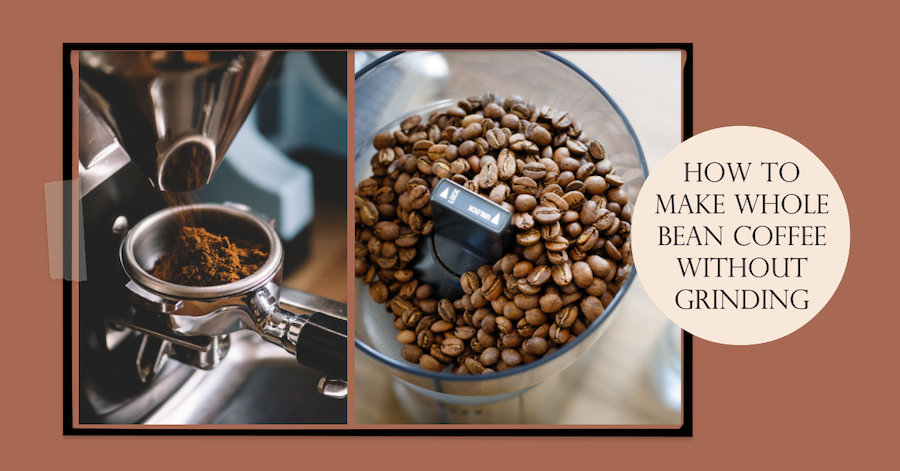
You can make coffee from whole beans, but the cup will be weak: a whole bean is the coarsest grind there is. If you must, steep them in the fridge overnight, as the NCA does with coarse grounds. Usually the better answer is to crush them with something you already own.
Safety: if you steep coffee for hours, keep it cold. We advise against starting a long steep with hot water and leaving it to cool on the worktop. The National Coffee Association’s cold brew method allows a 12-hour steep at room temperature, but Wisconsin’s food-safety guidance for cafés is stricter: brew and hold cold brew at 41°F (5°C) or below. The section on the 12-hour steep below has the details.
Extraction depends on how much bean surface the water can reach. The National Coffee Association puts the relationship plainly: “The size of your coffee grind has a significant impact on the taste of your coffee”, and if “Your coffee tastes flat or watery: it may be ground too coarse (under-extracted), so try a smaller, finer grind” (NCA, Drip coffee). Whole beans are the far end of that scale, and long steeping is the only lever you have left to make up for it.
Table of Contents
How to crush coffee beans without a grinder
This is what most people arriving at this question actually need. You do not need a grinder to break beans up; you need something that applies force. None of these produce an even grind, and unevenness is the real cost: fine particles over-extract into bitterness while coarse ones under-extract at the same time, in the same cup.
- Mortar and pestle. The most controllable option. Work in small batches, press and roll rather than pound, and stop when it looks like coarse sand rather than chasing an even powder you will not get.
- Rolling pin. Beans in a sealed freezer bag on a hard surface, pressed and rolled rather than hammered. Crushing beats smashing, because smashing makes dust and whole survivors at the same time.
- A blender. Only where the manufacturer sanctions dry grinding, and that is not a given. Vitamix publishes its own settings and times for coffee, so on those machines you are following the maker’s instructions rather than improvising — see grinding coffee beans in a Vitamix. Ninja is the opposite case: its documentation does not describe any of its blenders as a coffee grinder, and for at least one model it prohibits dry grinding outright, which is why our page on grinding coffee beans in a Ninja blender treats it as not sanctioned. Check your own model’s manual before you put dry beans in a jar, not after.
Because a hand-crushed grind is uneven and mostly coarse, it suits the long-contact methods — a press or a steep — rather than anything fast. That is the NCA’s general rule in reverse: “the longer the coffee is in contact with water during the brewing process, the coarser the grind should be.” None of this is a substitute for a burr grinder if brewing without one stops being occasional — our coffee tools and accessories page makes that buying case directly, with the mechanical reason a burr gives a more even grind than crushing or a blade ever will.
What each whole-bean method does
| Method | Verdict |
|---|---|
| Cold steep — beans in cold water, 12 hours or overnight, strained | The one that works without a grinder, because time substitutes for surface area. The NCA allows the fridge or room temperature; Wisconsin’s guidance for cafés says 41°F (5°C) or below. Start cold and use the fridge. |
| French press — whole beans, hot water, 4 minutes, plunge | Four minutes on whole beans extracts very little. Treat it as hot water with a hint of coffee unless you crush the beans first. Do not stretch a hot press into a long steep; for hours, use the cold steep above. |
| Coffee bag — beans in a filter bag, 4–5 minutes | Same problem, worse: the bag adds another barrier. It is a way to keep the beans contained, not a way to extract them. |
| Cowboy pot — beans and water boiled, settled, poured off | Boiling gets you more than steeping at the same time would, but you are still working against the surface area. |
| Percolator — beans in the basket, cycled | Check the basket first. Percolator baskets are sized for grounds, and whole beans in the wrong basket either fall through or sit in a heap the water goes around. |
Boiling whole beans in a cezve is cowboy coffee, not Turkish coffee. Turkish coffee is defined by the opposite of whole beans: our page on how Turkish coffee works explains that it is an unfiltered brew in which the grind has to be finer than espresso, because the grounds go into the cup and settle there. Calling boiled whole beans Turkish coffee misinforms people about a tradition UNESCO has inscribed on its intangible cultural heritage list.
Is a 12-hour coffee steep safe?
Two cases need separating here: a long steep in the fridge, which meets both the NCA’s method and the cold-holding temperature in Wisconsin’s guidance for cafés, and a long steep left at room temperature, whether it started hot or cold.
A twelve-hour room-temperature steep is not, by itself, an unsourced practice. The NCA’s own cold brew instructions say: “Let the coffee sit and steep in the refrigerator or at room temperature for 12 hours, or overnight”, and its summary of the method gives the water as “Room temperature or cooler, then served immediately or chilled in the refrigerator” (NCA, Cold brew coffee). Our page on cold brew versus nitro carries the NCA’s dose figures and explains why they are a concentrate ratio rather than a drinking ratio; we are not restating them here.
A hot start adds a cooling problem. For comparison, the FDA’s Food Code requires cooked food under time and temperature control to be cooled “Within 2 hours from 57ºC (135ºF) to 21ºC (70°F)” and “Within a total of 6 hours from 57ºC (135ºF) to 5ºC (41°F) or less” (FDA Food Code 2022, §3-501.14). A jug left to cool on a worktop cannot meet the second limit, because a kitchen is far warmer than 5ºC (41°F). The Code’s definition of the food these limits apply to includes “a plant FOOD that is heat-treated”, but its inspection rules group “coffee service” with food “that is not TIME/TEMPERATURE CONTROL FOR SAFETY FOOD” (§8-401.10), so the Code does not settle whether brewed coffee counts. Treat the limits as a benchmark, not a rule for coffee.
Be clear about the limits of that comparison. The Food Code governs retail and food-service establishments, not your kitchen. The regulator guidance we found on brewed coffee is about cold brew made by businesses: Wisconsin’s agriculture department says cold brew made without a heat step “requires refrigeration”, and a café there needs no special safety plan if its cold brew is brewed, held and served at 41°F (5°C) or below and date-marked for no more than seven days (Wisconsin fact sheet). We found nothing comparable for a hot steep left out overnight, so this page will not tell you that one has made anyone ill, and it will not print a safe holding time it does not have. What it will say is that a hot steep cooling on a worktop would not meet the cooling benchmark above, and that a twelve-hour steep in the fridge meets both the NCA’s method and that cold-holding temperature. If you are steeping anything for a day and intend to keep or share it, ask a food safety authority rather than a coffee blog.
For brew water temperature, the range and its source are on the best temperature for French press coffee. If a steeped batch has gone cold and you want it hot, the best way to reheat coffee covers that, including the superheating hazard of microwaving a liquid.
Corrections to earlier versions of this page
- A hot “infusion”. An earlier version gave an “Infusion Method” that poured “hot water (not boiling)” over the beans, left them “for around 12 hours at room temperature”, and finished: “Your coffee is now ready to heat and serve.” This page no longer gives that method.
- Cold brew and food safety. An earlier version said cold brew “never enters the temperature range where food-safety guidance requires action” and that we could find no regulator guidance on cold brew. Both were wrong: Wisconsin’s guidance for cafés says cold brew made without a heat step “requires refrigeration”.
- Turkish coffee. An earlier version called boiling whole beans in a cezve for ten minutes “The boiling method or Turkish coffee method”. It is now listed as cowboy coffee.
- Crushing. An earlier version did not cover crushing beans without a grinder.
- It had the strength relationship backwards. The page said: “Avoid using too many beans. It’s easy to think that more beans will lead to stronger coffee, but this isn’t always the case. Too many beans can result in an overly bitter or acidic cup.” More coffee to the same water makes the drink stronger, full stop. Bitterness and sourness come from over- and under-extraction, which are set by grind size and contact time, not by dose. The Specialty Coffee Association’s home brewer standard specifies “The standard brew ratio of 55 g of coffee per 1.000 kg of 17±3°C water” (SCA Standard 310-2021, Home Coffee Brewers, §7.1.5) — about 1:18 by weight — and our page on how many beans per cup of coffee works it through. Note that a coffee “cup” in these figures is 6 fl oz, not 8.
- It claimed whole beans brew a better cup than ground coffee. “When you make coffee with whole beans without grinding, you preserve the bean’s complete flavor profile”, it said, going on to promise stronger flavours and “subtle notes coming forward that you might miss in ground coffee.” That inverts the mechanism. Whole beans stay fresher for longer than pre-ground coffee, which is true and is why you buy them whole; but flavour has to be extracted to reach the cup, and an unbroken bean is the hardest possible thing to extract from. Freshness in the bag and extraction in the brewer are two different things, and the page had merged them.
- Unsourced freshness numbers. “Coffee beans are at their best in terms of flavor and aroma within a month of being roasted, with their peak freshness within the first week or two.” No source. The direction is uncontroversial; the windows are not ours to state.
- An FAQ block repeating the method list, and a closing paragraph promoting a Vitamix as “a worthwhile investment” with “precise control over the grind size” — a claim about a product on a page about not owning one. The link to our Vitamix page stays, in the section where it is relevant; the sales pitch does not.