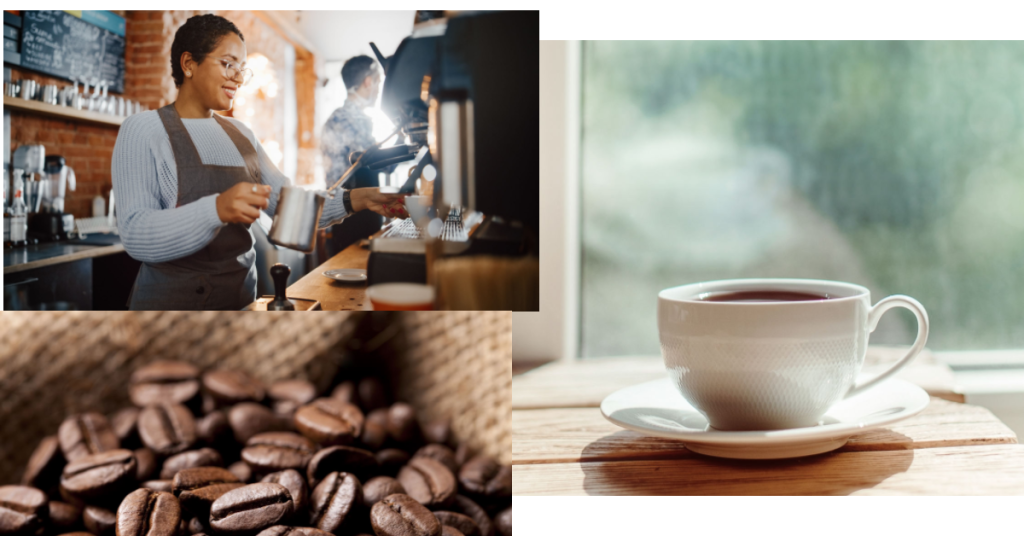
A house blend is a roaster’s or cafe’s own everyday blend, the coffee it sells as its default and pitches as balanced and approachable. The term has no federal legal definition, so it means what the seller says: Starbucks’ House Blend is a medium roast, Community Coffee’s is medium-dark and Peet’s is dark.
Table of Contents
What does house blend coffee mean?
It means the seller’s own standard blend, and the sense shifts with who is selling it. Coffee Review’s Kenneth Davids, its editor-in-chief, called it “a slippery term in coffee” in a 2009 tasting report on house blends, and gave it three overlapping meanings:
- The reliable everyday one. It can suggest “the straightforward and reliable, as in ‘house wine'”.
- The one you can’t get elsewhere. It can mean “something unusual but local, not to be had elsewhere”.
- The supermarket and chain one. He places the third in “the mid-market world of Starbucks and similar upscalish supermarket coffees”, where the name seems to describe a blend roasted a little darker than a “breakfast blend” but “not nearly as dark as blends labeled ‘espresso roast’ or ‘French roast'”.
Davids adds that “house blends, unique or not, are generally expected to offer value to the customer”. The roasters’ own pages (read on 1 October 2026) agree on a pitch of balance rather than on any recipe. Starbucks says its House Blend has “Aroma, body and flavor all in balance.” Peet’s calls its House Blend “rich and approachable”, and Community Coffee opens its description with “A perfectly balanced cup”. The table below shows how differently the three roast it.
“House” does not always mean made in-house, either. Davids calls Counter Culture’s Hominy Grill Blend “a different kind of house blend”, the “house” being “one of the many excellent restaurants for which Counter Culture provides custom blends”.
What is house coffee?
House coffee most likely means the coffee a place pours by default. None of the dictionary, trade-body or roaster sources we checked defines the term; Davids’s comparison of house blends with house wine, “the straightforward and reliable”, points the same way, but that is our reading, not a sourced definition. If it matters, ask what is in the pot and when it was roasted.
Is there a legal definition of house blend coffee?
No, not at the federal level, and we checked. For foods the FDA regulates, the rules that decide what may be sold under a particular name are its standards of identity: the reason “milk chocolate” (21 CFR 163.130) and “peanut butter” (21 CFR 164.150) mean specific things.
Those standards sit in Title 21 of the Code of Federal Regulations, parts 130 to 169. We read the title of every part in that range on the eCFR, current to 29 September 2026. They cover milk and cream, cheeses, frozen desserts, bakery products, cereal flours, macaroni and noodle products, canned fruits and fruit juices, fruit butters and jellies, canned vegetables, vegetable juices, frozen vegetables, eggs, fish and shellfish, cacao products, tree nut and peanut products, beverages, margarine, sweeteners and table sirups, and food dressings and flavorings.
Coffee is not on that list at all. The one part covering beverages, 21 CFR part 165, has a single standardised beverage in it: bottled water, at § 165.110. So there is no federal standard for “coffee”, let alone for “house blend”. Nothing stops a seller labelling any coffee a house blend, and nothing obliges them to say which coffees are in it or to keep the recipe the same next year.
That is the federal position; we have not surveyed every state’s food code. It is also not an accusation. Blending in good faith is normal and skilled work. It is just a reason to read the rest of the bag rather than the two words on the front.
Is house blend a light, medium or dark roast?
It depends on who sold it. These are the roast levels three roasters state on their own House Blend pages, read on 1 October 2026:
| Roaster | Roast level it states | Tasting notes it lists |
|---|---|---|
| Starbucks, House Blend | Medium | Toffee and dusted cocoa |
| Community Coffee, House Blend | Medium-dark (its scale runs from Light to Extra Dark) | Milk chocolate, berry and caramel |
| Peet’s, House Blend | Dark | Spice, citrus and toast |
Same two words, three roasts, and the vocabulary differs too: Starbucks sorts its coffees into Blonde, Medium and Dark roasts, Peet’s into Bright, Medium and Dark, and Community Coffee uses a scale that runs from Light to Extra Dark. The National Coffee Association says the same in general terms: “one roaster’s dark coffee may be different than another’s, and most roasters have specialized names for their roasts” (NCA, Roasts). The range has also run lighter: in 2009 Coffee Review described the “dramatically light roast” on a Johnson Brothers Fair-Trade Organic House Blend. For why “medium” is not a fixed quantity, see our guide to coffee roast levels.
House blend vs breakfast blend
Breakfast blend is another name the seller chooses. The NCA notes that “Referring to medium roast coffee blends as breakfast blends is also common.” Two sellers that make both put the breakfast blend lighter: Starbucks calls its Breakfast Blend “our lightest medium roast coffee” against a medium House Blend, and Peet’s lists its Breakfast Blend as a medium roast against a dark House Blend. That fits the convention Davids described in 2009, but it is a convention, not a rule, and two sellers are not a survey.
House blend vs French roast
These are different kinds of name, so they are not really rivals. “French roast” describes how dark the beans are: the NCA says “If you see ‘Italian roast coffee’ or ‘French roast coffee,’ that’s a dark roast.” “House blend” says nothing about darkness, which is why Starbucks’ is medium and Peet’s is dark. Coffee Review adds that roast terms like French and Italian “can be confusing because their use varies so widely” (Coffee Review, Roast Definitions). Compare the roast level printed on each bag, and see what French roast actually means.
What does house blend coffee taste like?
There is no house-blend flavour, because there is no house-blend recipe. The three roasters above list three different sets of notes: toffee and dusted cocoa at Starbucks; milk chocolate, berry and caramel at Community Coffee; and spice, citrus and toast at Peet’s. Those are the sellers’ descriptions. We have not tasted these coffees and can’t vouch for them.
Davids is clear about what a house blend tries to avoid: “Aggressive acidity, of course, is a no-no for house blends because it limits accessibility, as does a bitterish or extreme dark roast.” On his account the usual aim is a cup with no sharp edges, not a particular flavour.
Is house blend coffee strong?
It depends which “strong” you mean, and the name settles none of them. Flavour intensity is the roaster’s choice: Peet’s says its House Blend is “deep-roasted to bring out bold flavor, bright spiciness, and smooth balance”. Caffeine is a different matter. The NCA warns, “Don’t be fooled by the strong, rich flavor of those dark roasts”, because that character “is not associated with caffeine levels”. Species matters too: the NCA says arabica is “lower in caffeine” than robusta and that robusta “is primarily used in blends and for instant coffees”, so a blend that doesn’t say 100% arabica may contain some. We cover it in our page on robusta coffee beans.
Why do roasters make a house blend?
Roasters give several reasons for blending, and three of them fit a house blend.
- Consistency. Matt Milletto of Water Avenue Coffee told Coffee Review that blending “offers the opportunity to create a product that is relatively stable from year to year both in flavor and in price point” (Coffee Review, Blending Coffees, 2018). Phil Goodlaxson of Corvus Coffee explained why the recipe still has to move: “Our blends are constantly evolving because the lots we are purchasing for them are seasonal and sometimes very small.” Not every roaster blends for this reason: Per’La’s Paul Massard said “A lot of larger roasters blend for consistency; we blend to create new flavor combinations”. But a seller that wants its everyday coffee to taste the same next season has one.
- Balance. A blend lets a roaster set one coffee against another. Davids praised Counter Culture’s Hominy Grill Blend for “an impressive balance that wraps around and tames the coffee’s acidity without depriving us of its roundly tart pleasure”. His yardstick is a “properly versatile, you-all-come style house blend”: a cup meant to suit a whole table, not one enthusiast.
- Cost. Davids says house blends are “generally expected to offer value to the customer”, and spells out the implication: “step back from the Kenyas and the fancy microlots and you can save a few bucks while still drinking a great coffee that everyone at the table will enjoy.” Coffee Review’s Kim Westerman is blunter that cost can also drive a poor blend: one roaster’s goal “might simply be to use up back-stocks of green coffee, resulting in haphazard blends designed with cost-savings as top priority”. So a low price is a motive, not a verdict on quality in either direction.
A packaged supermarket brand is the other kind of blend, and the format is older than it looks: Yuban launched in 1913 as Arbuckle Bros.’ high-grade packaged coffee, sitting above their mass-market Ariosa, and is owned today by The Kraft Heinz Company. The consistency such a brand chases runs across a national retail line rather than one cafe’s daily pot.
House blend vs single origin
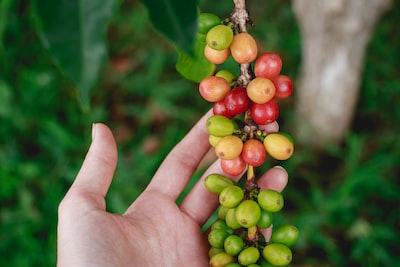
A single origin is sold on the flavour of one place; the NCA describes it as “emphasizing one distinctive and often complex flavor” (NCA, Varieties). Because it comes from particular lots, it can change from one lot to the next, which is the problem a blend is built to smooth out. Neither is better; they answer different questions, and the trade-off is a trade-off rather than a ranking.
One caution to carry between them: “single origin” is no more tightly defined than “house blend”. The NCA says single-origin coffee “comes from one farm, region or country”, which spans one farm to a whole country, and the FDA check above covers it as much as it covers blends. If you want to get the most out of one, we cover the practical side in how to brew single-origin coffee at home.
What to check on the bag instead of the name
- A roast date, not only a best-before date. The NCA says coffee “begins to lose freshness almost immediately after roasting” and suggests buying “enough for one or two weeks” at a time (NCA, Storage and Shelf Life). The date it was roasted is the one that tells you how old it is. A best-before date on its own does not.
- Whether the origins are listed. None of the three House Blend pages we read names a single country: Starbucks gives Latin America, Peet’s gives the Americas, and the Community Coffee page gives none. Peet’s does list countries for its Breakfast Blend (Brazil, Guatemala and Colombia), so naming origins is a choice a seller can make. A blend that names its origins is telling you something. One that does not may still be excellent, but you are buying the seller’s reputation rather than information.
- A stated roast level. Useful as the roaster’s own shorthand, but it is their scale, not an industry one, as the table above shows.
- The species, if you care. “100% arabica” is a claim about the beans. “House blend” is not. The Starbucks and Community Coffee House Blend pages both list 100% arabica coffee as the ingredient; the Peet’s page we read does not give a species. We cover both species in our pages on arabica coffee beans and robusta coffee beans.
And the test that beats all of the above: buy a small bag, brew it the way you actually brew, and decide. A house blend is designed to be the coffee you drink without thinking about it. If it is doing that job for you, it is the right one, whatever the label does or does not mean.
Where did the term “house blend” come from?
We did not find a source that documents when sellers began calling a blend a “house blend”, so we are not giving a date or an inventor. What can be sourced is narrower.
- Blending itself is old. The NCA’s history of coffee credits the Dutch in Indonesia with “the world’s first coffee blend”, Arabian coffee (called Mocha) combined with coffee grown on Java, and says “you can still enjoy a fresh cup of Mocha Java today”. That “first” is the NCA’s claim; we have not checked it against a second history.
- One brand dates its own. Starbucks says its House Blend is “the very first blend we ever created for you back in 1971”.
- The supermarket sense is newer. In 2009 Davids wrote that “over the last decade it has taken on still another meaning”, the mid-market one described above.
Corrections to earlier versions of this page
- An earlier version of this page said that most house blends are medium-roasted. That was unsupported: we found no published count of house blends by roast level, and the roasters’ own pages above show medium, medium-dark and dark. Davids described a middle-of-the-road convention for supermarket and chain blends in 2009, but that is an observation about one part of the market, not a count.
- An earlier version said a house blend is roasted “to sit in the middle of that seller’s range”. That does not hold for every seller: Peet’s lists its House Blend as a dark roast and its Breakfast Blend as a medium one.
- An earlier version said: “Each coffee shop has its unique house blend, offering a distinct flavor that you won’t find anywhere else.” That was wrong. Davids describes house blends as “unique or not”, and some restaurants’ house blends are custom blends made for them by an outside roaster. The blend may be proprietary; it may be someone else’s.
- An earlier version included a comparison table that scored house blends “High” for balance, consistency and versatility and other blends “Varies”. That was wrong in design: it compared a named thing with everything else and awarded the win to the named thing. It carried no information and has been removed.
- An earlier version said the term “started gaining traction with the rise of coffee shops and cafes” as they “sought to differentiate themselves.” That was a plausible guess presented as history. We could not source it then and have not since.