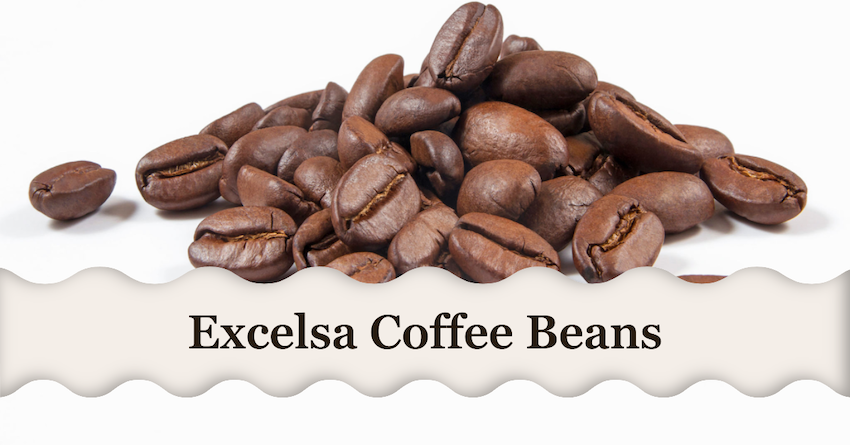
Excelsa is native to Central Africa, not Southeast Asia, and its correct scientific name is Coffea dewevrei. Its wild range runs across the Republic of the Congo, Cameroon, the Democratic Republic of Congo, the Central African Republic, South Sudan and Uganda. It is farmed today in Uganda, South Sudan, India, Vietnam, Malaysia, the Philippines and Indonesia — which is where the “Southeast Asian origin” story comes from, and why it is wrong: those are the places it was taken to, not where it came from. Genomic work led by the Royal Botanic Gardens, Kew and published in Nature Plants in 2025 re-established it as a species distinct from Liberica.
Table of Contents
This page previously cited a study that does not exist
The most serious problem with the old version of this page was a fabricated citation, and it needs stating plainly rather than quietly deleting.
The page said: “A study published in the Journal of Nutrition found that coffee consumption was associated with a reduced risk of all-cause mortality, cardiovascular disease, and several types of cancer” — and linked that sentence to PubMed Central record PMC9410941.
We opened that record. It is “Profile of Bioactive Compounds, Aromas, and Cup Quality of Excelsa Coffee (Coffea liberica var. dewevrei) Prepared from Diverse Postharvest Processes”, published in the International Journal of Food Science in 2022. Wrong journal, wrong title, wrong subject. The paper is a chemical and sensory analysis of processing methods and says nothing at all about mortality, cardiovascular disease or cancer. The health claim has been removed. So has a second claim on the same page — that antioxidants in Excelsa are “linked to a lower risk” of type 2 diabetes, certain cancers and neurodegenerative disease — which had no citation behind it either. This page makes no health claims and is not medical advice; if you have a reason to be careful about caffeine, that is a conversation with a clinician, not with a coffee site.
The irony is that the mis-cited paper is genuinely relevant. Its title contains the taxonomy the rest of the old page got wrong.
The taxonomy, in the order it actually happened
- Historically, excelsa circulated under the name Coffea excelsa, which is what the old version of this page used.
- In 2006, C. excelsa, C. dewevrei and C. dybowskii were sunk into Coffea liberica, with excelsa treated as C. liberica var. dewevrei — a variety of Liberica, not a species. That is the name the 2022 paper above uses in its title.
- In 2025, Davis and colleagues at Kew sequenced 353 nuclear genes across 55 samples and found three distinct lineages. Their conclusion: “Genomic and other datasets support the division of Coffea liberica into three species: C. liberica, C. dewevrei (excelsa) and C. klainei” (Davis et al., Nature Plants 11: 1729–1738, 2025). Excelsa is a species again — but under the name Coffea dewevrei, not C. excelsa.
So the old page’s answer that Excelsa and Liberica are “two distinct coffee varieties” landed on the right side of a question it did not know was open, using a name that had been superseded and a rationale that was made up. Both are now stated properly. Note also that older references, including plant databases that have not yet been updated, will still show C. excelsa as a synonym of C. liberica var. dewevrei; that reflects the 2006 treatment, not the current one.
Where excelsa grows and why growers are planting more of it
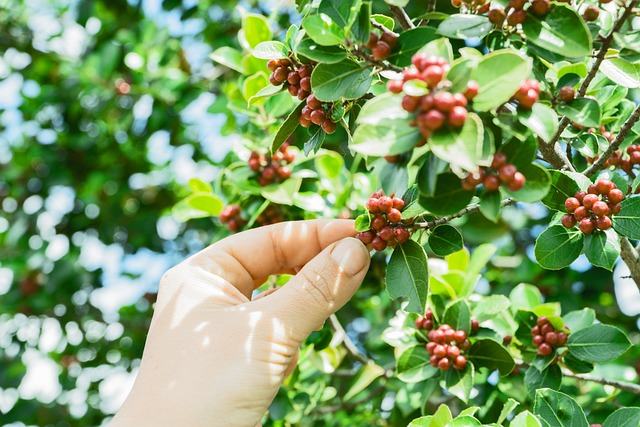
The Kew study is specific about the ecology, and it explains the commercial interest better than any tasting note does. In the wild, C. dewevrei occupies mid-elevations — a mean of 654 m — while C. liberica and C. klainei sit in the lowlands at means of about 386 m and 273 m. In cultivation, excelsa is “principally farmed at mid-elevations (500–1,200 m), with cooler temperatures (a mean annual temperature of 22–25 °C)”, and it shows “a considerable measure of drought tolerance, particularly compared with C. canephora“.
That drought tolerance is the whole story of its current expansion. The paper describes excelsa production as “steadily increasing” and “now being upscaled, particularly in Uganda, South Sudan, India, Vietnam, Malaysia, the Philippines, Indonesia” — much of it planted where Arabica and Robusta growing conditions are deteriorating. Our page on climate change and coffee farming covers the pressure driving that shift.
The bean itself is smaller than Liberica’s despite the plant being large: Kew gives seed dimensions of 7.7–11.3 × 5.4–8 mm and fruit of 1.2–2.5 × 0.8–2.1 cm, describing the seeds as “similar in size and shape to Arabica”. That is a useful practical detail — excelsa is far easier to process and roast on Arabica equipment than Liberica is.
What it tastes like — and what we removed
Nobody at this site has cupped excelsa, so this page will not publish tasting notes as though it had. What can be sourced is this: the 2022 International Journal of Food Science study cupped Indonesian excelsa prepared by several post-harvest processes and scored every sample above 80 points, with a top score of 83.83 for one natural-processed lot — specialty grade by Arabica scoring conventions. The authors summarised the character as “more similar with typical fruity aroma of Arabica”, and identified roasted, nutty pyrazines alongside phenolic and smoky guaiacol among the impact compounds. The Kew paper adds only that “Liberica and excelsa have contrasting coffee flavour profiles”, which is why the market treats them separately.
Three things the old page asserted have been deleted rather than corrected, because there was nothing to correct them against:
- Caffeine percentages. The page printed “1.9% – 2.4%” for excelsa, “1.2% – 1.5%” for Arabica and “2.7% – 4.0%” for Robusta with no source. The Kew study reports no caffeine figures for any of the three Liberica-group species, and the 2022 processing study reports caffeine only qualitatively. Rather than substitute numbers from somewhere else, this page now states that we could not source published caffeine figures for excelsa.
- A ten-row comparison table rating excelsa, Robusta and Arabica on acidity, body, aroma, price range and market demand. None of it was measured or cited.
- “Discovered and cultivated in the late 19th century” in Vietnam and the Philippines. Wrong hemisphere, as above.
Buying and brewing it
Excelsa is a small, specialist crop, so the buying advice is mostly about traceability: look for a roast date, a named country and producer, and the processing method, because the 2022 study’s own finding is that processing moved the cup score more than anything else. Given the seed size sits close to Arabica, standard Arabica grind settings are a reasonable starting point rather than a guess.
Start at 55 g of coffee per 1 litre of water — about 1:18 by weight, the standard brew ratio in SCA Standard 310-2021, Home Coffee Brewers: “55 g of coffee per 1.000 kg of water”. For water temperature see our page on the best temperature for French press coffee. Filter brewing gives you the most information about an unfamiliar coffee; save espresso for the second bag.
Affiliate disclosure: the two links below are paid links. As an Amazon Associate I earn from qualifying purchases. Your price is the same either way. Neither brewer has been tested by us — they are the two standard filter devices, listed because filter brewing is what this section recommends.
For the species this one keeps being confused with, see our pages on Liberica coffee beans, Arabica coffee beans and Robusta coffee beans.