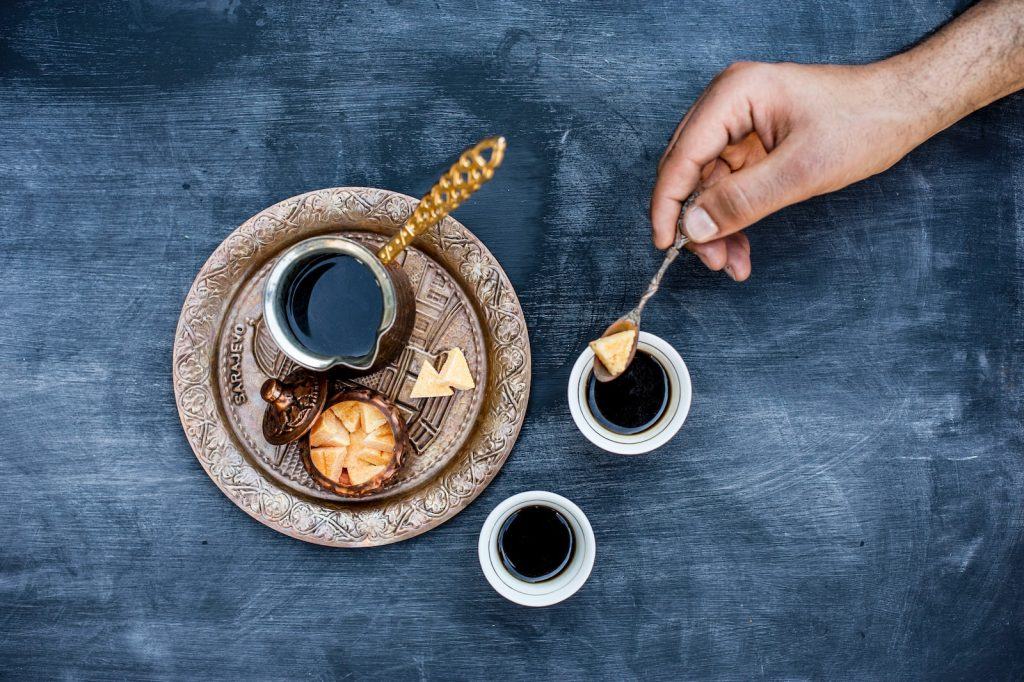
Turkish coffee is coffee cooked in a cezve, a small long-handled pot, and served unfiltered, grounds and all. A powder-fine grind goes in with cold water, and sugar if you want it. Over about three minutes of low heat the foam rises twice; it is spooned into the cups, then the rest is poured in, and the grounds settle.
Table of Contents
What is Turkish coffee?
The Turkish Language Association’s dictionary (TDK) defines Türk kahvesi as “Cezve ile kısık ateşte, şekerli orta veya sade olarak pişirilen kahve” (coffee cooked in a cezve over low heat, medium-sweet or plain). It is named for the way it is brewed, not for where the beans grow, according to a 2009 Gazi University paper (Küçükkömürler and Özgen). UNESCO inscribed “Turkish coffee culture and tradition” on its Representative List of the Intangible Cultural Heritage of Humanity in 2013.
How does Turkish coffee work? What UNESCO and Türkiye’s culture ministry say
The clearest short description of the method comes from the UNESCO element file (inscribed 2013, 8.COM):
“Turkish coffee combines special preparation and brewing techniques with a rich communal traditional culture. The freshly roasted beans are ground to a fine powder; then the ground coffee, cold water and sugar are added to a coffee pot and brewed slowly on a stove to produce the desired foam. The beverage is served in small cups, accompanied by a glass of water, and is mainly drunk in coffee-houses where people meet to converse, share news and read books.”
Türkiye’s own Ministry of Culture and Tourism gives the same sequence on its Kültür Portalı page for Turkish coffee culture. The beans are ground “toz haline gelene kadar” (until they become powder) in a “havan veya öğütücü” (mortar or grinder). Then, “isteğe bağlı olarak” (optionally), “kahve, soğuk su ve şeker cezveye koyulur” (coffee, cold water and sugar go into the cezve), and the pot goes on the heat “yüzeyde köpük oluşacak şekilde” (so that foam forms on the surface). It is served with a glass of water and Turkish delight. The translations are ours. In the English nomination file that Türkiye submitted to UNESCO, the sugar step reads “sugar, if desired”.
Four details set it apart from filter or espresso coffee:
- Powder grind. UNESCO and the ministry both say powder. The Gazi paper says it is finer than the espresso grind, which the National Coffee Association’s grind chart lists as “Fine (like table salt)”.
- Cold water, added with the coffee. Coffee and water heat up together, unlike a filter brew, where hot water meets the grounds. UNESCO and the ministry say cold water; the tourism portal GoTürkiye says room temperature.
- Sugar in the pot, not the cup. It goes in before heating, so you’re asked how you take it before the coffee is made. The roaster Kurukahveci Mehmet Efendi says the same in its own description: no sweetening is needed after pouring.
- Foam, not a hard boil. UNESCO and the ministry say to heat until foam forms. GoTürkiye adds: “Take care not to let the coffee boil to avoid it becoming bitter and watery.” Other recipes differ on this; the second table after the steps sets them side by side.
How do you make Turkish coffee in a cezve, step by step?
The most specific recipe we opened is on the tourism portal GoTürkiye. We haven’t brewed it ourselves; these are its steps and numbers.
- Put a teaspoon of coffee in a small, empty, dry cezve.
- Add sugar to taste (amounts in the table below).
- Add one coffee cup of room-temperature water. The Mehmet Efendi brew guide measures the water with the coffee cup itself, and the Gazi paper repeats that.
- Stir well before the pot goes on the heat, and never after. The Gazi paper says stirring “would dissolve the foam”.
- Heat on low for about three minutes. At the first rise (about 80 °C), lift the pot before it reaches the brim, spoon equal amounts of foam into the cups and put the pot back.
- At the second rise (about 90 °C), take it off again before it reaches the brim and let it sit for a few seconds. Don’t let it boil.
- Pour into the cups and serve with a glass of water and a piece of lokum (Turkish delight).
| Order it as | Meaning | Sugar in the cezve |
|---|---|---|
| sade | plain | none |
| az şekerli | a little sweet | 1 sugar cube (2–3 g) |
| orta şekerli | medium sweet | 1½ sugar cubes (3–4.5 g) |
| şekerli | sweet (“very sweet” on the portal’s English page) | 2 sugar cubes (4–6 g) |
The sources we opened differ on when to stir, whether to let it boil, how long it takes and how the amount is stated. The Gazi paper credits its recipe passage to mehmetefendi.com (2008), so its column relays the roaster rather than giving a separate recipe. This page’s steps follow GoTürkiye, the only one of the three that gives temperatures.
| Step | GoTürkiye | Mehmet Efendi | Gazi paper (2009), citing mehmetefendi.com |
|---|---|---|---|
| When to stir | “Stir the mixture well before placing the cezve over the fire. And never stir it after it is placed over the fire.” | “Heat slowly, stirring well”, until it starts to foam | “No stirring is done beyond this point, as it would dissolve the foam” (once the pot is on the fire) |
| Boil or not | “Take care not to let the coffee boil” | “Bring the coffee to another boil” | “Just as the coffee begins boiling, the pot is removed from the fire” |
| Time | “approximately 3 minutes” | “It only takes two minutes to prepare” | Not stated |
| Coffee per cup | “a teaspoon of coffee” | “one teaspoon coffee per cup (6 g)” | “between one and two heaped teaspoons” |
What temperature and coffee-to-water ratio does Turkish coffee use?
GoTürkiye puts the foam’s two rises at about 80 °C and 90 °C and says not to let it boil; the association’s analysis, as quoted in the 2019 article, gives 95 °C for the second. GoTürkiye gives no measuring method, the 2019 article gives none for the association’s figure (we haven’t opened the analysis itself), and we haven’t measured any of them. The standard drip range, 90 to 96 °C (about 194–205 °F, set out on our page about the best temperature for French press coffee), does not carry over, because a cezve starts cold with the grounds in the water throughout.
The ratio is measured differently too. Our house reference for drip brewing is 55 g of coffee per 1.000 kg of water, roughly 1:18, from SCA Standard 310-2021, which is written for automatic home drip brewers (the SCA now offers it only to members, so the link is a copy). The cezve recipes measure by the cup or the person, not by the liter, and the cup is a small serving cup, not the 6 fl oz measure our dosing pages use: the table above gives each recipe’s amount, and the association’s analysis, as quoted in the 2019 article, asks for at least seven grams per person. No recipe gives the cup’s volume. If Mehmet Efendi’s 65 ml serving, from its caffeine table, is the cup its guide means, 6 g of coffee to 65 ml of water (taking the serving as the water) is about 92 g per liter (our arithmetic), against 55 g per liter for drip.
What is a Turkish grind, and is it finer than espresso?
A Turkish grind is a powder, and yes, it is finer than espresso. UNESCO says the beans are “ground to a fine powder” and GoTürkiye says “freshly ground to a powder”. The Gazi paper says they are ground “even finer than the grind used in pump-driven espresso makers” and calls it “the finest grind of coffee used in any style of coffee making”.
There is one published particle size. The 2019 article quotes the association’s 2012 technical analysis (Naci Özgür, Türk Kahvesi Standartları ve Pişirme Ekipmanları Teknik Analizi) as asking that 70 to 75 percent of the ground particles measure around 75–125 microns. We haven’t opened that analysis, only the article, so read the figure as reported, not verified.
The Gazi paper calls grinding in a mortar “the authentic method” and a mill “the more usual method today”. Drip or espresso grounds are too coarse, and whole beans are not an option (see the corrections below). We haven’t tested any home grinder, so check its specification for a Turkish or extra-fine setting.
What is in Turkish coffee?
Coffee, water and, if you want it, sugar. The TDK definition above names no other ingredient, and the nomination file lists the same three.
Flavorings are optional and mostly regional. The 2019 article lists hazelnut, cardamom, clove, marjoram and mastic as traditional additions. A 2022 paper (Kavlak and Akova) lists mırra, süvari, dibek, menengiç and sütlü (milk) coffees as regional varieties, so a version with milk exists but isn’t the standard drink.
On beans, neither UNESCO nor the ministry names a species. The 2019 article says arabica is generally used but other suitable beans can be, and that Türkiye imports its coffee. For what arabica and robusta change in a cup, see our pages on Arabica coffee beans and Robusta coffee beans.
How does a cezve (Turkish coffee pot) work, and is it the same as an ibrik?
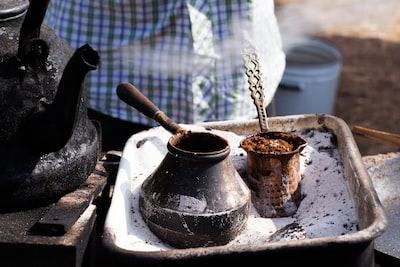
A cezve is the small pot Turkish coffee is cooked in. Everything goes in cold, and you lift the pot off the heat as the foam rises (see the steps above). TDK defines it as “Kahve pişirmeye yarayan, saplı, küçük kap” (a small handled vessel for cooking coffee). The Gazi paper calls it “a narrow-topped small boiling pot”, GoTürkiye a “small long-handled pot”, and Mehmet Efendi’s page on traditional tools says cezves are made of copper or brass.
An ibrik is the same pot under its Arabic name: the Collins English Dictionary defines ibrik as “the Arabic name for cezve” (entry). In Turkish the word means something else: TDK defines ibrik as “Su koymaya yarayan kulplu, emzikli kap” (a handled, spouted vessel for holding water). In Türkiye, ask for a cezve.
We opened no official or roaster guide that describes a substitute pot. The alternative the roaster describes is “a specially designed coffee machine”, and the 2022 paper notes that machines now cook it electrically in about two minutes.
How does Turkish sand coffee work?
Sand coffee, kumda kahve (“coffee in sand”) in Turkish, is Turkish coffee cooked in hot sand instead of over a flame. The 2022 paper lists it among the names Turkish coffee takes from how it is cooked, alongside ash (kül kahvesi), embers (közde kahve) and grill (tiryaki kahvesi) coffee.
How the sand does its job is described by a seller of the equipment, not by any official or scholarly source we opened. The seller’s glossary says the pot “is placed in hot sand, allowing the coffee to heat slowly and evenly”, claims “better flavor extraction” (which we could not check), and says: “Remove the cezve briefly from the sand when the foam reaches the top to prevent overflowing.” So the sand stands in for the flame, and you manage the heat by lifting the pot.
UNESCO’s element file, the nomination file and the ministry’s page describe brewing on a stove and never mention sand, and no source we opened measures the sand’s temperature or compares a sand-brewed cup with a stove-brewed one.
How do you drink Turkish coffee?
Water first, then the coffee, and leave the grounds. GoTürkiye says: “The water is taken before the coffee, in order to cleanse and prepare the palate to fully appreciate the richness of the aromas in the coffee.” Mehmet Efendi’s guide says: “The water prepares the mouth for the coffee’s flavor.”
Give the cup a moment. Mehmet Efendi’s description says the coffee “must be left to stand for a short time after serving to allow the grounds to settle at the bottom of the cup.” Traditional cups were small and handleless, held “with the tip of the fingers or, more often, by placing the cup in a zarf, a metal container with a handle” (Gazi paper). Special guests are served in “special coffee cups more elaborate than the ones used daily”, says the nomination file.
When the cup is empty, the custom is to turn it over. The nomination file describes it: “the cup is rotated, a wish is made, the cup is turned upside down on the saucer, left for cooling.” UNESCO adds: “The grounds left in the empty cup are often used to tell a person’s fortune.”
Do you drink the grounds in Turkish coffee?
No. You drink the coffee and leave the settled grounds. The Gazi paper says: “there is no need to filter the coffee grounds as it sinks at the bottom of the cup after it is cooked.” TDK defines telve, the grounds, as “Fincanın dibine çöken kahve tortusu” (the coffee sediment that sinks to the bottom of the cup). The 2019 article quotes the association’s analysis as treating a layer about 1 cm thick in the cup as desirable.
What does Turkish coffee taste like, and how strong is it?
We haven’t tasted it, so these are other people’s descriptions, from the ministry, a university paper and a roaster. The nomination file, Türkiye’s own submission to UNESCO, says: “It is softer, more aromatic and more concentrated than other types of coffee.” The Gazi paper describes “soft and velvet like foam” and “thick syrup”; Mehmet Efendi, a “thick, syrupy consistency”. None of this was measured. GoTürkiye says boiling makes it “bitter and watery”, and sweetness is your choice, set before brewing.
For caffeine, the only figure we opened is the roaster’s: Mehmet Efendi’s page on its characteristics lists 60 mg for a 65 ml cup of Turkish coffee, with no method. We opened no independent measurement, so treat it as a vendor’s claim.
What is Turkish coffee called in Turkish?
Türk kahvesi. The nomination file gives the element’s name in Turkish as “Türk Kahvesi Kültürü ve Geleneği” (Turkish Coffee Culture and Tradition). Kahve is the word for coffee, and the English word comes from it: the American Heritage Dictionary traces coffee to Ottoman Turkish qahve, from Arabic qahwa. The meanings below follow the TDK dictionary.
| Turkish | Meaning |
|---|---|
| kahve | coffee: the tree, its bean, the ground powder and the drink |
| fincan | the small cup, usually handled, for hot drinks |
| telve | the coffee sediment that sinks to the bottom of the cup |
| köpük | foam, the mass of air bubbles on a liquid that is boiled or shaken |
| havan | mortar, a vessel for pounding and crushing |
| lokum | Turkish delight |
Where does Turkish coffee come from, and what makes it traditional?
The tradition goes back to Istanbul’s coffeehouses in the 16th century. The nomination file says: “Turkish coffee culture and tradition goes back to the 16th century when coffee started to be served at coffeehouses in Istanbul.” The National Coffee Association says that “by the 16th century it gained popularity in what we now know as Iran, Egypt, Syria, and Turkey” (NCA, history of coffee). It is called Turkish for the method: the Gazi paper says “Coffee is named according to the way it is brewed not to the land it is grown.”
What the sources call traditional: grinding in a mortar, cooking in a copper or brass cezve, small cups with a glass of water and lokum, and company. UNESCO calls the tradition “a symbol of hospitality, friendship, refinement and entertainment”, with a role at engagement ceremonies and holidays, and says its knowledge is “transmitted informally by family members through observation and participation”. At an engagement, GoTürkiye says, the bride-to-be prepares and serves the coffee to the suitor and his elders. The proverb the ministry quotes, Bir fincan kahvenin kırk yıl hatırı vardır, reads on GoTürkiye as “A cup of coffee commits one to forty years of friendship”. For other documented traditions, see our page on global coffee ceremonies.
If you want to buy a cezve
Affiliate disclosure: please read this before the link, not after it. The single product link below is a paid link: if you buy through it, this site earns a commission and your price is unchanged. As an Amazon Associate I earn from qualifying purchases. We have not bought, used or tested this pot, and it is listed as an example of the right kind of vessel, not as a recommendation over any other. The Federal Trade Commission’s endorsement rules say: “In any communication using an interactive electronic medium, such as social media or the internet, the disclosure should be unavoidable.” (16 CFR § 255.0(f)) That’s why it sits here rather than in a footer.
Look for the shape the sources describe: a small, narrow-topped, long-handled pot, in copper or brass if you want the traditional material. One example is the DEMMEX copper cezve, 9 fl oz. For the grinder, see the grind section above, or buy coffee already ground for a cezve.
Corrections to earlier versions of this page
- An earlier version of this page said Turkish coffee has a distinctively rich, full flavor, offered “a sensory journey like no other” and printed a table rating four brewing methods on taste. That was wrong to state as fact: none of it was measured or sourced, and it has been removed.
- An earlier version said sand brewing gives a richer, fuller flavor than a direct flame. That was wrong to state: nobody here has made that comparison, and no source we opened measures it.
- An earlier version said Turkish coffee “uses Arabica beans, which are known for their superior quality and flavor”. That was wrong: neither UNESCO nor the ministry names a species. Our page on Arabica coffee beans covers the question.
- An earlier version suggested making Turkish coffee from whole beans without grinding. That was wrong: every source describes a powder. Our page on making coffee with whole beans without grinding covers what whole-bean methods do instead.
- An earlier version carried a link with the anchor text “Ibrik” that pointed, through a shortened Amazon redirect, at an Amazon search-results page rather than a product, with no disclosure anywhere on the page. That was wrong: it has been replaced by one disclosed, full product link.
- An earlier version translated the ministry’s havan veya öğütücü as “a hand mill or grinder”. That was a mistranslation: havan is a mortar, as the TDK dictionary and the nomination file (“in a mortar or in a mill”) show.
- An earlier version said the point of foaming is “at or near boiling” and “outside that range by design”, and that the grounds are “consumed with the drink”. That was partly wrong: GoTürkiye puts the two rises at about 80 °C and 90 °C, short of boiling, and says not to let the pot boil, while Kurukahveci Mehmet Efendi describes Turkish coffee on its own site as “the only coffee that can be boiled” (Mehmet Efendi), so not every source agrees; nothing we opened says the temperature is outside the usual range by design; and the grounds settle in the cup and are left there.