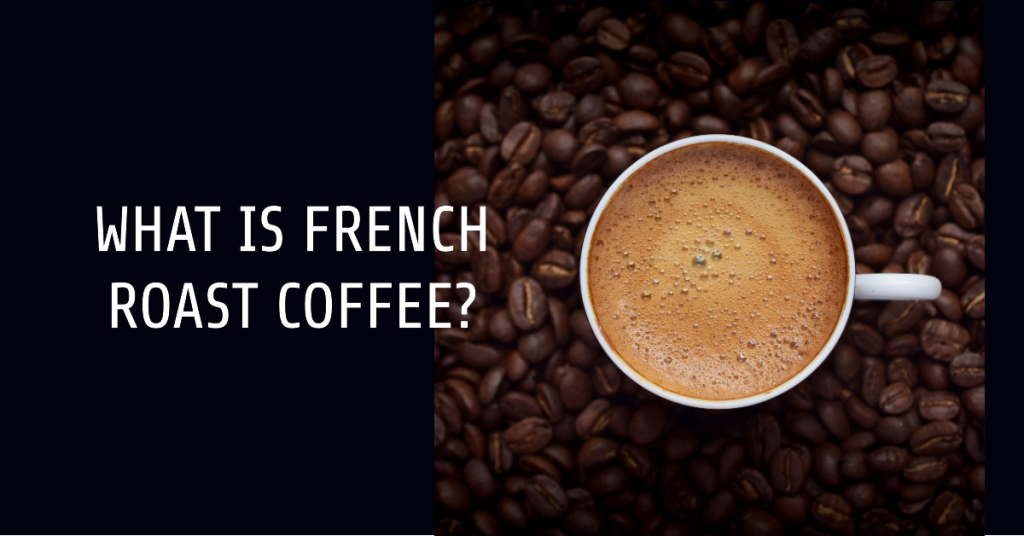
French roast is a dark roast. It names a roast color, not a bean, a growing region or where the coffee comes from: any coffee can be sold as French roast if the roaster takes it dark enough. On the National Coffee Association’s light-to-dark list it sits second from the end, just before Italian roast.
The NCA is clear that the list is a convention rather than a rule, because “one roaster’s dark coffee may be different than another’s” (NCA, Roasts).
Table of Contents
What does French roast look and taste like?
| Source | What it says about French roast |
|---|---|
| National Coffee Association | Second from the dark end of its list of popular roast names, before Italian roast; dark roasts are shiny and oily, with “a pronounced bitterness”, and less acidic than lighter roasts |
| Hottop roaster manual | Reached at “fast second crack”; beans very dark brown and “Very shiny/oily” |
| Ukers, All About Coffee (1922) | “the bean is cooked until the natural oil appears on the surface” |
Hottop’s manual describes the taste at that stage: “The coffee usually acquires a similar sharp taste, with the flavor being predominantly ‘roast’ and less that of ‘coffee.'” (Hottop roaster manual).
Roasted that far, what you taste is mostly the roast, per Hottop’s manual above, and the NCA says “lighter roasts will preserve more of the unique qualities of a coffee compared to a darker roast”. The surface of the beans is oily, because at that stage oil has migrated out of the bean’s broken-down structure — the mechanism is covered in why some coffee beans are oily. Those are category descriptions, not tasting notes for any particular bag; nobody at this site has cupped the coffee you are about to buy.
Does French roast have less caffeine?
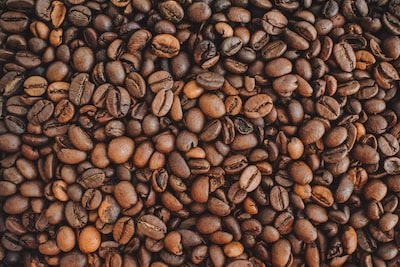
Per scoop, yes, and by a margin. Per gram, barely. In a 2024 study, a level scoop of ground coffee from the darkest of five roasts of one coffee held about 40% fewer grams than the lightest (0.242 against 0.415 g/mL; Lindsey et al., supplementary table S1).
The measurement is on the side of “barely”. A 2024 study roasted two green coffees to five degrees of roast each and measured caffeine in the brew by HPLC at a fixed weight ratio of 15 parts water to 1 part coffee. Caffeine in the cup did not fall steadily with roast; it peaked in the middle — “Maximum values for caffeine concentrations (in 10-min brews) were observed in roast batches with ∼14–16% roasting losses (generally light to medium roast levels)” — and only dropped once the bean probe passed roughly 400–420 °F, toward the dark end of the study’s roasts (Lindsey et al., Scientific Reports 2024;14:29126). At a full 10-minute brew the five roasts of one coffee ran from 161.3 to 165.0 mg per 8 oz cup, and of the other from 151.9 to 165.4 mg (the study’s supplementary tables S3 and S4); the study’s 134–165 mg range includes 1-minute brews.
The scoop effect is real but it is a measuring problem, not a coffee problem: roasting removes mass and adds porosity, so a scoop of French roast weighs less than a scoop of a light roast. Weigh your dose and it goes away. The full explanation, with the numbers, is on our coffee roast levels page. The National Coffee Association is blunt about the intuition that leads people here in the first place — its own rebuttal of it is quoted in full on our coffee roast levels page rather than repeated here.
How much caffeine is in French roast?
The FDA page cited here gives no figure for French roast as such. It cites “400 milligrams a day — that’s about two to three 12-fluid-ounce cups of coffee — as an amount not generally associated with negative effects”, and immediately qualifies it: “there is wide variation in both how sensitive people are to the effects of caffeine and how fast they eliminate it from the body.” Its own table puts “coffee, regular brewed non-specialty” at 113 to 247 milligrams per 12 fluid ounces, a more than two-fold spread, and its list of too-much-caffeine symptoms runs “increased heart rate, heart palpitations, high blood pressure, insomnia or sleep disruptions, anxiety, jitters, upset stomach, nausea, headache” (FDA, Spilling the Beans). Note the FDA’s cup is 12 fl oz; a brewing “cup” is 6 fl oz. Our coffee bloat page works through the cup sizes.
Where does the name French roast come from?
We found no source for how the name began. An early description we found is in William Ukers’ All About Coffee (1922), which describes “the extremely dark roast in vogue in France, Italy, Brazil, Turkey, and in the producing countries” and lists French and Italian among the roasts the North American trade recognized, in his words. That records a dark roast liked in France a century ago; it does not show where the name came from. In current usage the NCA’s roast list treats “French roast” and “Italian roast” as names on a spectrum of dark, not a place or a process; the NCA’s exact wording is quoted on our Italian roast vs French roast page. The names describe how dark the roaster went. They do not tell you where the coffee grew, who roasted it or when.
Is French roast darker than Italian roast?
On the National Coffee Association’s roast list, French roast sits one step lighter than Italian roast, and Italian is last on the NCA’s list, though that ordering is a roaster’s convention rather than a fixed scale, so one roaster’s French roast can be darker than another’s Italian. In current NCA usage the two differ little beyond that: acidity is low in both, and caffeine moves a little with roast level but a lot with dose — the fuller side-by-side, with a comparison table, is on our Italian roast vs French roast page.
Brewing it
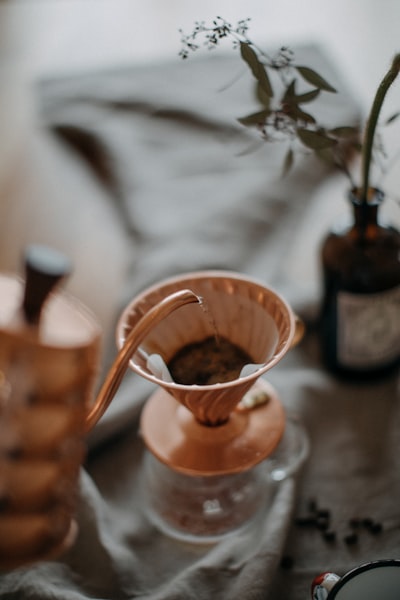
Ratio. The house figure is 55 g of coffee per 1.000 kg of water (1:18 by weight); the Specialty Coffee Association’s exact wording and the source PDF are on our coffee roast levels page rather than restated here. Two things follow from it: a coffee “cup” is 6 fl oz, not 8, and a stronger cup means more coffee, not less.
Temperature. 194 to 205 °F (90 to 96 °C), with the sourcing and the reasoning on our best temperature for French press coffee page rather than restated here.
Method. If a cup comes out bitter and flat, the first two things to try are less contact time and a coarser grind, not hotter water.
Disclaimer: This page is general information, not medical advice. Caffeine figures quoted here are regulatory guidance or one study’s laboratory measurements, not a limit or a figure for your cup. If you are pregnant, trying to become pregnant, breastfeeding, taking prescription medication, or managing a heart, blood-pressure, anxiety or sleep condition, talk to your own clinician or pharmacist about caffeine rather than relying on a general figure.
Corrections to earlier versions of this page
An earlier version of this page said, word for word:
French Roast is typically roasted to a darker level compared to Italian Roast. French Roast beans have a rich, dark brown color, while Italian Roast beans are roasted even further, resulting in a shiny, almost black appearance.
Both halves of that cannot be true, and the first half is the wrong one. The NCA lists “Popular roasts you may see on coffee packaging, from light to dark” as blonde or cinnamon roast, city roast, full city roast, Vienna roast, French roast, Italian roast — French first, Italian last. So the second half of the old sentence was right and the first half was backwards. This page is the site’s primary answer to what French roast is; our separate page comparing it against Italian roast already placed Italian as the darker of the two and links here for the fuller explanation, rather than the two pages repeating each other.
The page also contradicted itself about acidity. In one section it described French roast as having “low acidity”; in another it warned that “the bold and intense flavors of French Roast Coffee can be accompanied by a higher acidity level.” Only the first is consistent with the trade body, which states that with darker roasts “your brewed coffee will be even less acidic than lighter roasts.” Dark roast tastes harsh to some people, but harsh and acidic are not the same thing, and the low-acidity statement is the correct one.
The URL of this page promises “origins to health benefits”, so it needs saying plainly: the health-benefits section did not cite a single source and it is gone. It claimed French roast is “rich in antioxidants, such as chlorogenic acid and polyphenols” with benefits “including reducing inflammation and protecting against chronic diseases”, that caffeine can “improve cognitive function”, and that caffeine has “a thermogenic effect, which can temporarily increase metabolism and aid in weight management.” None of that was tied to a study, none of it was specific to French roast rather than coffee in general, and a page about roast colour is the wrong place to make disease claims.
Also corrected: an earlier version labeled French roast’s caffeine “Lower” in a summary table with no measure attached; it said the French “favored a darker roast, which led to the birth of what we now know as French Roast Coffee”, with no source; it described the taste with unsourced adjectives (bittersweet, smoky, heavy in body, near-charred); it told readers to use a 1:16 ratio; it gave brew times (4–5 minutes for French press, 2–3 for pour-over, 25–30 seconds for espresso) with no source; it gave the caffeine spread as 134–165 mg, a range that includes 1-minute brews; and it gave the brewing temperature as 195–205 °F, now 194 to 205 °F (90 to 96 °C).