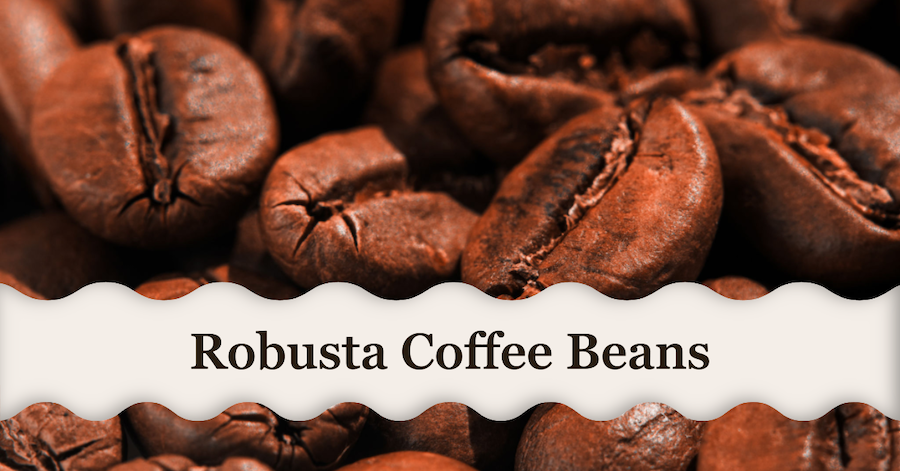
Robusta is the trade name for coffee from the species Coffea canephora. It carries more caffeine than arabica, grows lower and hotter, and made up 36.6% of world green-coffee exports in coffee year 2024/25 on International Coffee Organization figures. Vietnam is the largest robusta producer, with 36% of world robusta output in 2025/26 on USDA figures.
Strictly, “robusta” names a group of varieties inside that species, not the species itself. World Flora Online gives the accepted name as Coffea canephora Pierre ex A.Froehner, published in 1897, in the genus Coffea, family Rubiaceae. The export share is a subtraction, and worth showing: the ICO reports that “the Arabicas’ share of the total green beans exports in coffee year 2024/25 fell to 63.4% from 63.7%”, and it splits green bean exports into arabicas and robustas only, so the remainder is the robustas (ICO Coffee Market Report, October 2025).
Table of Contents
Where the name came from
“Robusta” was a nurseryman’s product name before it was anything else. William Ukers’s 1922 trade history records it plainly: “Emil Laurent, in 1898, discovered a species of coffee growing wild in Congo. This was taken up by a horticultural firm of Brussels, and cultivated for the market. This firm gave to the coffee the name Coffea robusta, although it had already been given the name of the discoverer, being known as Coffea Laurentii” (Ukers, All About Coffee).
The commercial name outlived the botanical one, and it has drifted further since. A 2021 review in Foods notes that “most commercial coffee sold as ‘robusta’ is not Coffea canephora var. robusta, but of other varieties (probably mostly hybrids)” (Olechno et al., Foods 2021;10(6):1208). So “robusta” on a bag tells you the species and very little else.
How much more caffeine does robusta have than arabica?
About 50 to 90 percent more, depending on which published range you compare: midpoint to midpoint, the narrower ranges give about 90 percent and the wider, overlapping ranges about 50 percent.
The same Foods review gives composition figures for green beans on a dry-weight basis. In one passage of its introduction, for arabica and robusta respectively, it reports caffeine at 0.9–1.2% and 1.6–2.4%; midpoint to midpoint that is close to a doubling, which is where “almost double” comes from. A few sentences later the same introduction gives wider ranges that overlap: “Arabica green beans contain, on average, 0.9 to 1.5% dry weight of caffeine. In contrast, Robusta green beans have between 1.2 and 2.4% of the alkaloid.” So the ranges give the fuller answer: a low-caffeine robusta and a high-caffeine arabica can be close together. A 2026 analysis of green beans grown on the Comoros measured robusta at 1.52%, inside the wider range and below the narrower one (Irchad et al., Metabolites 2026).
The National Coffee Association states the gap more conservatively, describing robusta as containing “50–60% more caffeine than arabica”. Both figures are published by credible bodies and they do not agree, which is itself the useful fact: robusta is meaningfully higher in caffeine, and anyone quoting a single precise multiplier is rounding away a real spread. If a dog eats coffee beans, robusta’s extra caffeine makes the dose worse, gram for gram: our page on dogs and coffee beans has the thresholds and the poison-control numbers.
None of that translates cleanly into what lands in your cup, because dose, grind and brew method move the number more than species does. For what a regulator says about daily intake, see our page on how long coffee bloating lasts, which quotes the FDA’s 400 mg figure with its cup size attached.
How much of the world’s robusta does Vietnam grow?
Vietnam is comfortably the largest robusta producer in the world. It is not, and on these figures has never been, above 40% of world robusta output. The USDA Foreign Agricultural Service publishes robusta production country by country in Coffee: World Markets and Trade; in the July 2026 edition, Vietnam’s robusta crop is 30.5 million 60-kg bags out of a world robusta total of 84.39 million for 2025/26 — about 36%.
| Marketing year | Vietnam robusta | World robusta | Vietnam share |
|---|---|---|---|
| 2021/22 | 30,480 | 77,955 | 39% |
| 2022/23 | 27,300 | 76,621 | 36% |
| 2023/24 | 26,550 | 72,175 | 37% |
| 2024/25 | 28,000 | 74,540 | 38% |
| 2025/26 | 30,500 | 84,390 | 36% |
| 2026/27 (forecast) | 31,400 | 83,800 | 37% |
The USDA figures above are from USDA’s July 2026 release; its next world coffee report is due on December 16, 2026.
The highest share in the whole table is 39%. The other large producers in the same table are Brazil, Indonesia, Uganda, India, Malaysia and Côte d’Ivoire, in that order.
One caution on percentages generally: export share and production share are different numbers. The ICO figure at the top of this page counts green beans crossing a border; USDA’s counts what comes off the trees, including everything drunk in the country that grew it. Both are right, and they will never match.
Growing conditions, briefly
The reason robusta exists as a separate crop is agronomic rather than sensory. It tolerates lower elevations and higher temperatures than arabica, which is why the map of robusta production is a lowland map. USDA puts the Brazilian side of it precisely: “Espirito Santo, where approximately 70 percent of Robusta coffee is grown.” The same trait is why robusta acreage tends to expand when arabica-growing conditions deteriorate — see climate change and coffee farming for the pressure behind that shift.
Processing is not species-specific. Cherries are either dried whole and hulled afterwards (the natural or dry method) or pulped and fermented before drying (the washed method), exactly as for arabica.
What does research say about robusta’s benefits?
Robusta’s real, sourced advantage over arabica is chemical: it measurably contains more chlorogenic acid as well as more caffeine. The same Foods review cited above for caffeine gives chlorogenic acids at 7–10% of dry weight in robusta green beans against 5.5–8% in arabica (Olechno et al., Foods 2021). Chlorogenic acid is coffee’s most abundant polyphenol and a genuine subject of ongoing metabolic research — a 2013 review in Evidence-Based Complementary and Alternative Medicine reports that “CGA ingestion significantly reduced early fasting glucose and insulin responses in overweight men” in an oral glucose tolerance test, but concludes plainly that “the mechanism on glucose and lipid metabolism has not yet been conclusively elucidated” (Meng et al., Evid Based Complement Alternat Med 2013:801457). That is the honest state of the science: a compound robusta contains more of, studied for a real effect, without a settled mechanism.
Robusta’s antioxidant capacity has also been measured directly rather than inferred from its composition. A 2026 laboratory analysis of Comorian robusta and excelsa green beans found robusta higher on every bioactive measure taken — total polyphenols (121.79 ± 2.73 mg GAE/g), total flavonoids (29.43 ± 2.20 mg QE/g) and antioxidant activity (64.97 ± 6.25 mM Trolox equivalent/g) — leading the authors to call Comorian robusta “a potent source of antioxidants and stimulants” (Irchad et al., Metabolites 2026;16(5):303). That is one study of one origin’s beans, not a global average, and a laboratory antioxidant assay measures a chemical property of the bean, not an outcome in the person drinking it.
What this page will not claim: the large epidemiological studies linking coffee drinking to lower rates of type 2 diabetes, Parkinson’s disease or liver disease do not separate robusta drinkers from arabica drinkers — most coffee-consumption research pools “coffee” as a beverage without recording which species the participants drank. Robusta containing more of the two most-studied compounds is a real, sourced fact. Whether that translates into a bigger benefit for the person drinking it is not a question the current literature answers.
Buying and brewing it
On the bag, look for a roast date, a named country and region, and a processing method. This page does not define “Fine Robusta”.
For filter brewing, start at 55 g of coffee per 1 litre of water — about 1:18 by weight, which is the standard brew ratio in SCA Standard 310-2021, Home Coffee Brewers, §7.1.5: “The standard brew ratio of 55 g of coffee per 1.000 kg of 17±3°C water”. Stronger means more coffee per litre, not less. A “cup” in coffee measurement is 6 fl oz, not 8. For water temperature, see our page on the best temperature for French press coffee, which gives the range with its attribution. Espresso is the other common use, and there the ratio convention is a different one — roughly 1:2, dose to liquid out.
Nothing on this page is medical advice. Caffeine affects people differently, and if a medical condition, a medication or a pregnancy is the reason you are counting it, that is a conversation with a clinician.
The other three commercial species
- Arabica — the varieties, the Yemen bottleneck and why every named variety on a specialty bag is this species.
- Liberica — a big-seeded species and, together with excelsa, a crop Kew puts at probably under 1,000 metric tons worldwide.
- Excelsa — Coffea dewevrei, re-established as a separate species in 2025 and planted where robusta is starting to struggle.
And if the “beans” in all of this has been bothering you, they are seeds: see are coffee beans legumes.
Corrections to earlier versions of this page
- An unedited writing-assistant line was published in the body. The sentence “Sure, here’s a table that provides a comparative view of Arabica and Robusta coffee beans:” was left in as prose. It is gone, and so is the table it introduced, which gave caffeine as “About 1.5%” and “About 2.7%”, sugar content as “about 9%” and “about 3%”, altitude as “600-2000 meters” and “0-800 meters”, and production as “About 60%” and “About 40%” — eight numeric claims, not one of them sourced.
- Two links were doing work they could not support. The phrase “tolerant to a wide range of environments” was linked to the ICO home page, and “high caffeine content” to the National Coffee Association home page. A link to an organisation’s front door is not a citation for a specific claim. Every source link on this page now points at the specific document that contains the sentence being quoted.
- Caffeine was described as robusta’s defence mechanism against disease. The NCA’s own comparison says only that robusta trees are “heartier, more resistant to disease and parasites”; it does not name caffeine as the mechanism. Caffeine’s role in plant defence is a real research question, but it was not what the cited page said, so the claim has been removed rather than restated.
- A nutrition block gave percentages of RDI for riboflavin, pantothenic acid, magnesium and potassium per 8 oz cup, with no source and using a cup size that is not the coffee cup. It has been deleted. So has the surrounding health section, which claimed caffeine “can help boost metabolism, aiding in weight loss efforts” with nothing attached.
- Origin was given as “specifically in Uganda and Guinea”. C. canephora is indigenous to a much broader band of tropical Africa than two countries. The species was described in 1897 from a Gabon type specimen, and the material that founded the modern crop was collected in the Congo in 1898, as above. The two-country claim has been removed rather than replaced with a range we could not source precisely.
- The tasting notes were not ours. “Burnt tire”, “rubbery”, “nutty, chocolatey” — nobody at this site has cupped a robusta, and the page presented those descriptors as findings. They are gone. What can be said without tasting anything is that robusta is used in espresso blends for body and crema and is the backbone of most instant coffee, which is a commercial fact about how the species is bought, not a flavour claim.
Also corrected: an earlier version said robusta has “almost double the caffeine content of Arabica” and that Vietnam contributes “over 40% of the world’s Robusta coffee output”; neither had a source, the second is wrong on USDA’s figures, and the first rounds away the ranges set out above. It recommended looking for “Fine Robusta” and defined the term with no source. And it said the two caffeine ranges in the 2021 review do not overlap, which is true of one pair in the review’s introduction but not of the other.