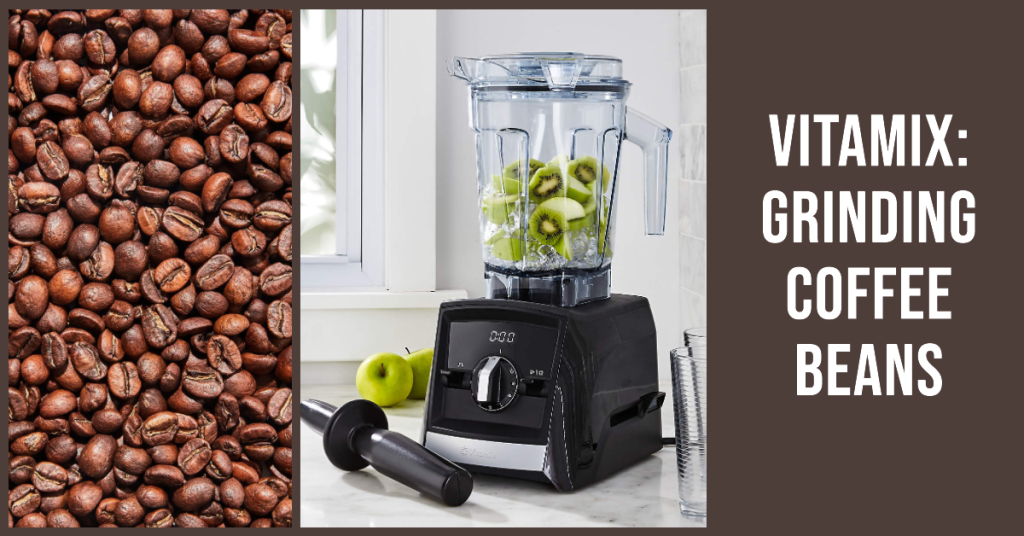
Vitamix says yes, and publishes the steps: start on Variable 1, bring it up to Variable 8, and grind 8 to 10 seconds for French press, 15 to 20 seconds for drip or pour-over, or 20 seconds plus pulsing for espresso. Its recipe uses 2 cups of beans per batch, and its article says to use the dry grains container.
Vitamix’s article on grinding coffee says: “To coarsely grind coffee beans in a Vitamix machine, attach the dry grains container and add the coffee beans. Select Variable Speed 1 and turn the machine on slowly, increasing the speed to Variable 8. Grind the coffee beans for 10 seconds” (Vitamix, How to Blend Coffee Beans in a Vitamix).
Table of Contents
How long do you grind coffee in a Vitamix?
Vitamix’s recipe page for Ground Coffee is more detailed than its article, and it is worth following verbatim rather than improvising. Every step runs at Variable 8, started from the lowest speed:
| Grind | Vitamix’s instruction | Target texture, in Vitamix’s words |
|---|---|---|
| Coarse | “blend for 8 – 10 seconds” | “should resemble coarse salt” (French press) |
| Medium | “blend for 15–20 seconds” | “should resemble breadcrumbs or coarse beach sand” (pour over, drip) |
| Fine | “blend for 20 seconds,” then scrape the walls and “continue grinding by pulsing on Variable 8” | “should resemble table salt or granulated sugar” (espresso) |
The same page specifies a batch size — “2 cups (160 g) coffee beans, roasted” — and notes that “This recipe works with anywhere between 2 and 3 cups of whole coffee beans.” In our reading, a blender jar needs enough volume for the beans to circulate, so grinding a single cup’s worth is the situation where a blade does its worst work.
Do you need the dry grains container?
Vitamix itself is not perfectly consistent here.
- Vitamix’s article on coffee says to “attach the dry grains container.”
- Vitamix’s recipe for the same task says only “Place coffee beans into the Vitamix container and secure the lid” — no container type specified.
The reason Vitamix’s grinding article gives for the Dry Grains Container is performance: “If you’ve ever tried to grind grains in a standard blender, you may have noticed that the unit spins but packs the dry ingredients under the blade where they remain either partially mixed or in their whole form,” whereas with a Dry Grains Container “you can grind coffee, grains, spices, seeds, and coffee beans easily. The blades in the container are specifically designed to create a reverse vortex, pushing dry ingredients away from the blades to prevent packing” (Vitamix, Grinding and Milling with Blenders). The same reverse-vortex wording appears on the container’s own product page.
Will grinding coffee damage a Vitamix?
Regular dry grinding can cosmetically mark the container and, over time, dull the blades, according to Vitamix’s 5200 owner’s manual. The manual warns that if the standard container is used for grinding, it “will mar and become cloudy”, and describes the dry blade container as “designed specifically for grinding dry materials such as grains, cereal, and coffee”. Even for that container it cautions: “Grinding dry material for more than two minutes could damage your machine. Regular use may result in cosmetic marring of the container and cause the blades to become dull over time.” (Vitamix 5200 owner’s manual, PDF). The two-minute limit is far above the 8 to 20 seconds Vitamix gives for coffee, and the manual does not single out coffee. If you own only the standard container, Vitamix’s own recipe page still tells you to grind coffee in “the Vitamix container”; in our reading, expect a less even grind and more material packed under the blade, which is what the dry container’s blade geometry exists to fix.
If you have a Ninja rather than a Vitamix, do not carry any of this across: Ninja’s owner’s guides say not to grind. See grinding coffee beans in a Ninja blender.
How much coffee can you grind at once?
Vitamix’s recipe uses 2 cups (160 g) of beans and says it works with 2 to 3 cups; it gives no quantity for a single cup’s worth. Vitamix also says “it is best to grind whole coffee beans just before brewing”, and to store any leftover grounds in an opaque airtight container at room temperature for 1 to 2 weeks (quoted under “Afterwards” below). For how much coffee to use per brew, the house figure across this site is by weight, because scoops of whole beans and scoops of grounds are not the same measurement: 1:18 — 55 g of coffee per 1 litre of water, the brew ratio specified in SCA Standard 310-2021. A coffee “cup” is 6 fl oz (about 177 ml), not 8, so one cup at 1:18 works out at roughly 10 g of coffee. Scaled up to a 12-cup pot, that’s about 117 g for a 72 fl oz carafe, or 98 g if your machine’s 12 cups hold 60 fl oz. And the direction people most often get backwards: stronger coffee means more coffee, not less water contact, not a finer grind. French press and pour-over have their own conventional ratios, which are legitimately different from the drip standard. For water temperature, see brew temperature.
Will a Vitamix grind coffee evenly?
Not as evenly as a burr grinder. A spinning blade cuts whatever happens to pass it, so some beans are hit repeatedly and others barely at all; a burr grinder instead crushes every bean through a fixed gap, which is what produces uniform particles. The clearest evidence is in Vitamix’s own fine-grind instruction: it tells you to stop, “remove the lid and scrape down the walls of the container,” and then finish by pulsing. That step exists because material is not circulating evenly.
The practical consequences: a blender is a good match for French press and cold brew, where a coarse and slightly uneven grind is forgiving. It is a poor match for espresso, where an uneven grind produces channelling no matter how long you run the machine — Vitamix lists espresso under its fine grind, but a pressurised shot is the hardest thing to ask of any blade. Between those, drip and pour-over are workable. We have not measured particle distribution from a Vitamix against a burr grinder; nobody here has run that test, and this page will not pretend otherwise. If you brew often enough that this becomes worth fixing, our coffee tools and accessories page makes the buying case for a dedicated burr grinder, with the mechanical reason a burr outperforms a blade either way.
Afterwards
Scrape the container out with a spatula — grounds cling to the walls and to the underside of the blade assembly. Wash and dry it before its next job, because coffee oils carry over into whatever you blend next. Vitamix’s own note on storing what you ground: “For maximum flavor, it is best to grind whole coffee beans just before brewing. Freshly ground coffee loses its flavor quickly, and should only be stored in an opaque airtight container at room temperature for 1–2 weeks, if not consumed right away.”
Grind for the brew you are about to make, and grind again next time. That is the one advantage a blender shares with a proper grinder, and it is the one that matters most.
Corrections to earlier versions of this page
- An earlier version gave “20 to 30 seconds” of grinding, a figure we could not trace to Vitamix; Vitamix’s own times are in the table above.
- An earlier version said we had found no Vitamix statement that grinding coffee damages the standard container or dulls the blades. Vitamix’s 5200 manual says grinding in the standard container “will mar and become cloudy” and that regular dry grinding may dull the blades over time.
- An earlier version gave the dose as “1 to 2 tablespoons of coffee beans per 6 ounces of water”; this site doses by weight.
- An earlier version said a Vitamix “can produce a consistent grind”. A blade cannot match a burr grinder for consistency.