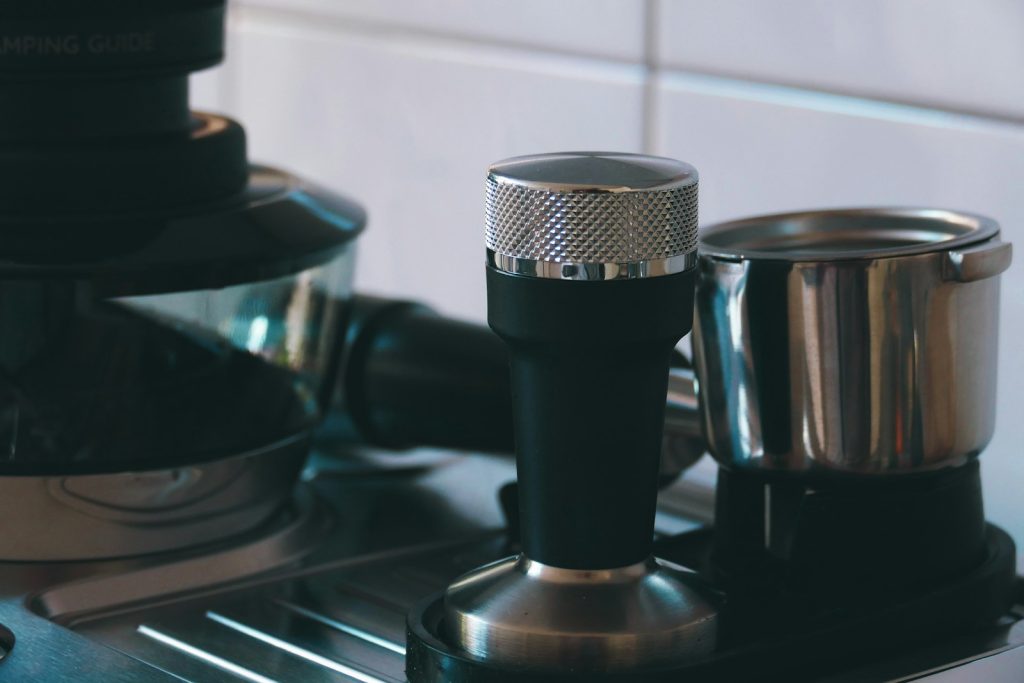
Four things do almost all the work: a burr grinder, a digital scale, a way to heat and pour water, and a brewer. Everything else on the usual accessories list is convenience. If you are buying in order, buy the grinder first — it is the only item that changes the coffee itself rather than how conveniently you make it.
Nothing on this page has been tested by us. What follows is what each tool does and what a source that is entitled to have an opinion says about it.
Table of Contents
The grinder — the only purchase that changes the coffee
The National Coffee Association gives the same recommendation on every one of its brewing guides: “We recommend using a burr grinder—whether at home or where you buy your coffee beans.” The reason is mechanical. A burr grinder “crushes coffee beans between a moving grinding wheel and a non-moving surface (the two ‘burrs’ in the name)”, and those “do a better job of creating a consistent grind, which allows the flavors of the coffee to extract more evenly, and they’re better for the types of coffee that require smaller grind sizes, like espresso or French press. They’re also less likely to overheat the grounds during the grinding process, preserving the coffee’s oils and aromas” (NCA). A blade grinder chops rather than mills, and produces a wider spread of particle sizes from the same beans.
Grind size follows the brewing method, and the NCA states the underlying rule: “As a general rule, the longer the coffee is in contact with water during the brewing process, the coarser the grind should be.” Its published sizes are French press coarse (like rock salt), cold brew coarse, drip medium (like kosher salt), pour-over medium, espresso fine (like table salt).
One measured detail worth knowing, from a study that ground coffees under controlled conditions: bean temperature affects the grind. “Grinding cold results in a narrower particle size distribution, and reduced mean particle size”, while the distribution “is independent of the bean origin and processing method” (Uman et al., Scientific Reports 6: 24483, 2016). Your grinder and the temperature of your beans control the grind; the origin on the bag does not.
If you do not own a burr grinder yet, that does not mean you cannot brew — our page on making coffee with whole beans without grinding covers the workable stopgaps, and where each one falls short of what a burr grinder does above.
The scale
The NCA lists a scale as required equipment for pour-over, French press and espresso, and gives the reason: “Using a digital scale to measure your coffee and water will help you brew more consistent French press coffee—and keep track of what worked well (or not) for you so you can keep adjusting and experimenting.”
The practical case is stronger than that, though. A tablespoon of coffee is not a fixed mass — it varies with grind size and roast level, so volume measurement introduces an error you cannot see. The published brewing standard is expressed as a mass ratio for exactly this reason: “The standard brew ratio of 55 g of coffee per 1.000 kg of 17±3°C water” (§7.1.5) (SCA Standard 310-2021, Home Coffee Brewers), which is about 1:18 by weight. Note also that a coffee “cup” means 6 fluid ounces, not 8 — the ambiguity is where most home dosing errors start. And stronger coffee means more coffee, not less. For a worked example of that 1:18 ratio, see how much ground coffee a 12-cup pot takes.
What to look for: 0.1 g resolution, a tare button, and a platform that fits under your brewer. A built-in timer is convenient rather than necessary.
The kettle and the thermometer
For pour-over the NCA specifies a kettle with a “thin ‘gooseneck’ that helps control the flow of water—and helps preserve the water temperature, too”, and lists a thermometer as equipment “unless one is built into kettle”. A variable-temperature electric kettle collapses those two items into one, which is the whole argument for buying one.
A thermometer is only useful if you know what you are aiming at, and that target is covered in full — with its source — on our page about the best temperature for French press coffee. It is not restated here.
The brewer, and the filter that goes in it
The NCA’s own equipment lists are the shortest honest summary of what each method needs:
| Method | Equipment the NCA lists |
|---|---|
| Automatic drip | Drip coffee maker, filters (unless the machine has a built-in basket), grinder |
| Pour-over | Pour-over brewer, filters, kettle, thermometer, scale, grinder |
| French press | French press, kettle, thermometer, scale, grinder |
| Espresso | Espresso machine, scale, grinder |
The French press needs no filter because the plunger screen is the filter; that is also why it produces a heavier cup. Which filter you use in the others is a real decision with a real effect, and it is covered on our page on coffee filter types — paper, metal and cloth rather than being summarised badly here.
If you would rather not own any of this, the honest alternative is a pod machine, and the trade-offs are laid out on our page about types of coffee pods. It is a genuine choice, not a lesser one — a pod machine fixes the grind, the dose and the temperature for you, which is what most of the equipment above exists to control.
Storage and cleaning, without the padding
Keep beans in an airtight, opaque container at room temperature, and buy quantities you will finish. Grind immediately before brewing: the NCA’s phrasing is that “buying whole coffee beans and grinding them immediately before brewing guarantees maximum freshness”.
Cleaning is mostly about oil. Coffee oils go rancid, they stick to burrs, baskets and carafes, and rancid oil is a flavour you will taste before you diagnose it. Rinse everything after use; take the grinder apart periodically and brush the burrs. If your beans are visibly oily to begin with, why some coffee beans are oily explains what that does and does not tell you about the roast.
Descaling is a separate job from cleaning — it removes mineral scale from anything that heats water, and the interval depends on your water hardness and your machine’s instructions, not on a rule of thumb. Follow the manufacturer’s schedule; we have not tested descaling products and are not naming one.
Product links — read the disclosure first
These are paid links. If you buy through one, this site earns a commission; your price is unchanged. As an Amazon Associate I earn from qualifying purchases. None of these products has been bought, used or tested by us. They are here because they are the standard, widely stocked examples of each category — not because they beat anything in a comparison, since no comparison was made. The Federal Trade Commission’s rule is that “in any communication using an interactive electronic medium, such as social media or the internet, the disclosure should be unavoidable” (16 CFR § 255.0(f)), which is why this paragraph sits above the links rather than below them.
- Burr grinders: Breville Smart Grinder Pro (BCG820BSSXL), Cuisinart DBM-8 Supreme Grind, Baratza Sette 270
- French press: Bodum Chambord, 34 oz
- Pour-over: Hario V60 ceramic dripper, Chemex classic pour-over coffeemaker
Once you have the four items at the top, the next question is where to put them: home coffee station ideas.
Corrections to earlier versions of this page
An earlier version of this page said, of a ceramic pour-over dripper, “we bought ours on sale from Amazon.com for $26”. It said of a French press, “We personally love the reputable Bodum French Press machine for ~$40 on Amazon.com. You won’t regret it.” It called a dripper “Our favorite”. None of that happened. Nobody at this site bought those products, used them, or compared them against anything. The prices were not observed. Those sentences have been deleted, and no first-person purchase or testing claim appears anywhere on this page now.
Three further things were wrong with the same section, and they are worth naming because a reader could not have seen any of them:
- The affiliate links paid a different website. Three of the product links carried an affiliate tag belonging to another site’s account. This site earned nothing from them; the commission went elsewhere. They have been replaced with links on this site’s own account, and every one is disclosed in the product links section above.
- A grinder comparison table was invented. It gave four grinders “User Ratings” of 4.5/5, 4/5, 4.7/5 and 4.3/5 and price bands of “$”, “$$” and “$$$”. No source, no test, no basis. It has been removed rather than re-sourced.
- Prices were made up. Milk frothers “for $30 to $70”, scales “$20 to $50”, thermometers “$10 to $30”. None of those ranges came from anywhere. This page now quotes no prices at all, because prices change and we are not tracking them.
Four sentences have been cut from this page entirely because they existed only to carry a link and said nothing: they began “If you’re curious, learn more about…”, “If you’re wondering…”, “If you’re interested, consider…” and “you might want to know…”. Where a link on this page is genuinely useful, it is because the other page owns that topic properly.
The old page also carried a link reading “top-rated espresso machine” that pointed at an Amazon search results page — not a product, and nothing about it was top-rated by anyone here. There is no espresso machine link on this page now, because we do not have a specific model we can name honestly.