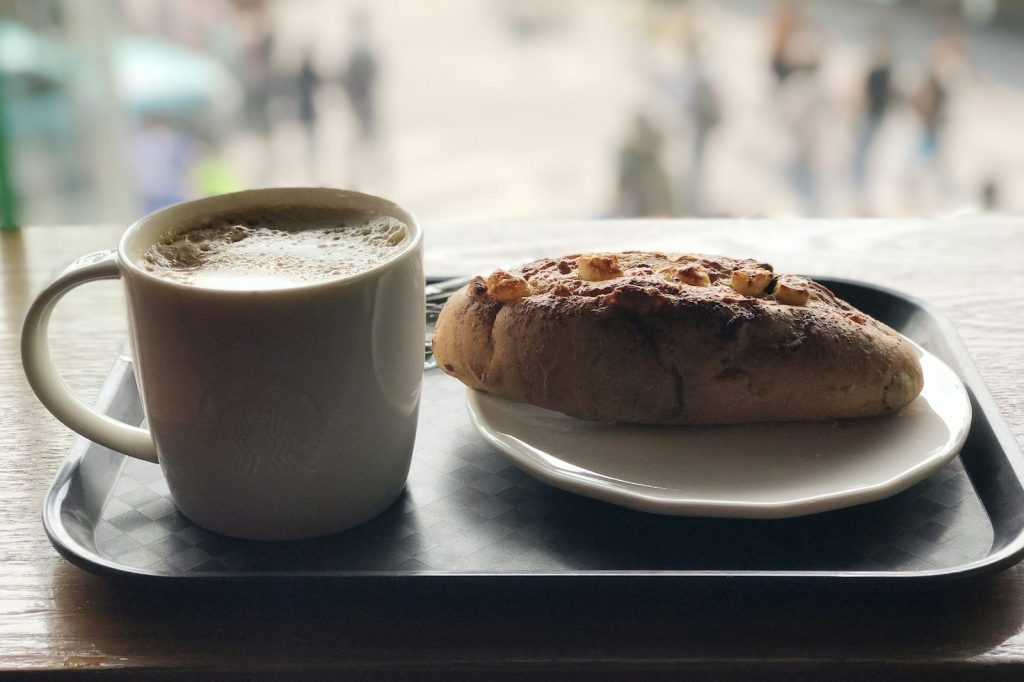
Little has been published on coffee and food pairing. One 2025 UC Davis consumer study (a conference poster) of four coffees and six foods found that an almond croissant and cheesecake paired well with all four coffees, while berries, the best-liked food on its own, made the least preferred pairing. Familiarity with the pairing mattered most.
A 2021 systematic review of food-pairing methods covered coffee alongside tea, wine and beer (Rune et al., Beverages), and the UC Davis study was presented as a conference poster (ASIC poster, PDF), not a journal paper. The review’s authors also ran their own experiment, pairing four coffees with a sweet and a savory food, and concluded that “coffee characterized as having chocolate, nutty, sweet notes are more suitable to be paired with food than coffees characterized as fruity, floral, berry” (Rune et al., International Journal of Gastronomy and Food Science, 2022). Beyond that, most pairing advice rests on convention plus two decisions you make every time: match the intensity of the coffee to the intensity of the food, and decide whether you want the two to echo each other or to cut against each other. Everything past that is preference, and preference is not a fact about the coffee. Nobody at this site has run a pairing trial, tasted the combinations below, or scored anything, so nothing here is stated as a result of ours.
Table of Contents
What goes with coffee? What a 2025 consumer study found
Jiexin Liang, Lik Xian Lim and Jean-Xavier Guinard of the University of California, Davis tested four coffees, a Colombian dark roast and coffees from Costa Rica, Ethiopia and Kenya, with six foods: chocolate, an almond croissant, a breakfast sandwich, a nut mix, berries and cheesecake. One group of 280 consumers tasted only the coffees and said which foods they expected to pair well; a second group of 238 tasted the coffees and foods together.
| What the study found | Which group |
|---|---|
| An almond croissant and cheesecake paired well with all four coffees. | Tasted together (N=238) |
| Berries were the best-liked food on their own, but their pairing with coffee was the least preferred. | Tasted together (N=238) |
| Most pairings were rated similar in complexity; chocolate was the exception, seeming more complex with the Colombian dark roast than with the Costa Rican coffee. | Tasted together (N=238) |
| Shared flavors or aromas between food and coffee did not necessarily make a better pairing. | Tasted together (N=238) |
| Desserts, chocolate, baked goods and pastries were expected to go well with the dark roast. | Coffee only, expected pairings (N=280) |
| Fruity and floral coffees were expected to go well with fruit. | Coffee only, expected pairings (N=280) |
| Bread and nuts were expected to go well with all the coffees. | Coffee only, expected pairings (N=280) |
| Rice and salads were expected not to go well with coffee. | Coffee only, expected pairings (N=280) |
The authors conclude that familiarity with the pairing “was the main driver of coffee and food pairing appropriateness or quality, but sensory congruency and hedonic congruency also resulted in high appropriateness ratings”, and that the more unusual combinations led some tasters to give high ratings. It is one study, four coffees and six foods, reported as a poster (ASIC 2025, #33898).
Our rule of thumb: intensity first, then echo or contrast
Intensity first. This is our rule of thumb, not a tested finding: a pairing fails when one side is louder than the other and the quieter side stops registering. A delicate filter coffee next to a slab of dark chocolate is not a subtle pairing; it is a coffee you can no longer taste. Match loud with loud and quiet with quiet, then start adjusting.
Then echo or contrast — but pick one. Echoing means putting a coffee and a food that share a character together, so the shared note is reinforced. Contrasting means using one to cut the other: acidity against fat, bitterness against sugar. Both are common approaches; what does not work is choosing neither and hoping. On shared flavors the UC Davis poster is mixed: they “did not necessarily contribute to the quality of the pairings”, yet sensory congruency “also resulted in high appropriateness ratings”.
Judge the pairing on the aftertaste, not the first bite. Almost anything is pleasant for two seconds. The SCA defines aftertaste as the perception “caused by the remnants of the brew inside the mouth and throat, after the brew has been ejected or swallowed” — and that is where a pairing either resolves or turns metallic and stale. The full vocabulary for this, with the standards it comes from, is on our page about coffee flavor profiles and how to taste. That page is the method; this one is what you do with it at the table.
What the coffee brings to the table
Three properties of the coffee do most of the pairing work, and two of them are set before you buy it.
- Roast level moves perceived acidity and bitterness in a documented direction, and it is the lever most people already have. We keep that with its source on coffee roast levels rather than restating it here.
- Processing shapes whether a coffee reads as fruity or as clean before roasting is even considered, and it will change a pairing more than the country on the bag does. We quote the National Coffee Association’s descriptions of the natural, washed and honey methods on how to taste coffee rather than repeating them here.
- Milk changes the problem completely. Milk mutes bitterness and adds sweetness and body of its own, so a milk drink and the same espresso taken black are not interchangeable partners for the same food. If you are working from a café menu, the difference between coffee and a latte is the relevant starting point, and how much creamer goes in coffee covers the same problem at home.
Traditions are customs, not evidence
Plenty of coffee cultures serve a particular drink with a particular thing to eat, and those customs are genuinely worth knowing. But a custom is evidence that people do it, not evidence that it is optimal.
Where this site describes a tradition, it does so on a page dedicated to that tradition, where the detail can be checked rather than compressed into a table row. Those pages are Turkish coffee, the four types of Cuban coffee and cortadito. If you want a themed tasting, borrowing one of those is a far better starting point than a continent-wide generalisation.
How to test a coffee pairing at home
This is the part that will actually tell you something, and it takes about twenty minutes. It is deliberately a comparison, because a pairing tasted on its own gives you no information at all.
- Brew one coffee, controlled. Same coffee throughout, at the house reference of 55 g of coffee per 1.000 kg of water — roughly 1:18 by weight — weighed rather than scooped. A coffee “cup” means 6 fluid ounces, and stronger means more coffee, not less.
- Taste the coffee alone first and write one line. That is your control. Without it you cannot tell whether the food changed the coffee or you simply were not paying attention the first time.
- Take the food, then the coffee, then the coffee again. The second sip after the food is the informative one, because the first is still competing with what is in your mouth.
- Ask one question: what got quieter? Our guess, not a finding: a failed pairing is usually a suppression rather than a clash, and the coffee’s acidity or its sweetness is what disappears.
- Rinse with plain water and repeat with the second food. Two foods against one coffee, not two of each — you are testing one variable.
- Write down which you would order again. That is an affective judgement, it is allowed to be personal, and it is the only conclusion this exercise can honestly produce.
If you are hosting, the same discipline scales: one coffee, several foods, everyone writing before anyone speaks. The moment the host announces what a pairing is supposed to do, the room tastes it, which is why the tasting notes on the back of a bag are so persuasive and so unreliable as a test.
None of the combinations you settle on will be facts about coffee. They will be facts about you, recorded properly, which is considerably more useful than a table of ideal matches assembled by someone who never ate any of them.
Corrections to earlier versions of this page
The earlier version stated preferences as findings, and in one case it stated two opposite preferences as findings on the same page.
- “No measured science”. An earlier version said “There is no measured science of coffee and food pairing.” That was wrong: there is little research, but the 2021 systematic review and the 2025 UC Davis study exist.
- It contradicted itself about acid and citrus. Near the top it said “A highly acidic coffee might overpower a citrus dish but balance a sweet pastry“. Further down it said “Lighter desserts like lemon tarts pair nicely with a bright, citrusy coffee“. Those are opposite instructions for the same combination, and neither had a source. The honest version is that both are common preferences and you will not know which you hold until you try it.
- Three tables presented taste as specification. Columns headed “Food Pairing Suggestions” and “Ideal Food Pairings” assigned foods to flavour profiles and to acidity levels with nothing behind them. “Ideal” is doing a lot of unearned work in a table nobody tested. They have been removed rather than rebuilt with softer adjectives.
- A table assigned a “Traditional Food Pairing” to whole continents. It gave Africa “Samosas, injera, spicy lamb dishes” and Asia “Dim sum, mochi, green tea pastries” — two continents, four billion people, one row each, no source. The body did the same thing in prose, claiming “African coffees can enhance spicier dishes“. Gone.
- It borrowed authority from wine. The old FAQ said acidity in coffee works “similar to how wine works“. Coffee is not wine, the analogy was not sourced, and it was being used to make a preference sound like a mechanism.
- Two sentences existed only to send you somewhere and did not even manage that. “Curious about coffee and beans? Learn why some coffee beans are oily to boost your understanding of pairings” was not a link at all, and oily beans have nothing to do with what you eat with them. Removed.