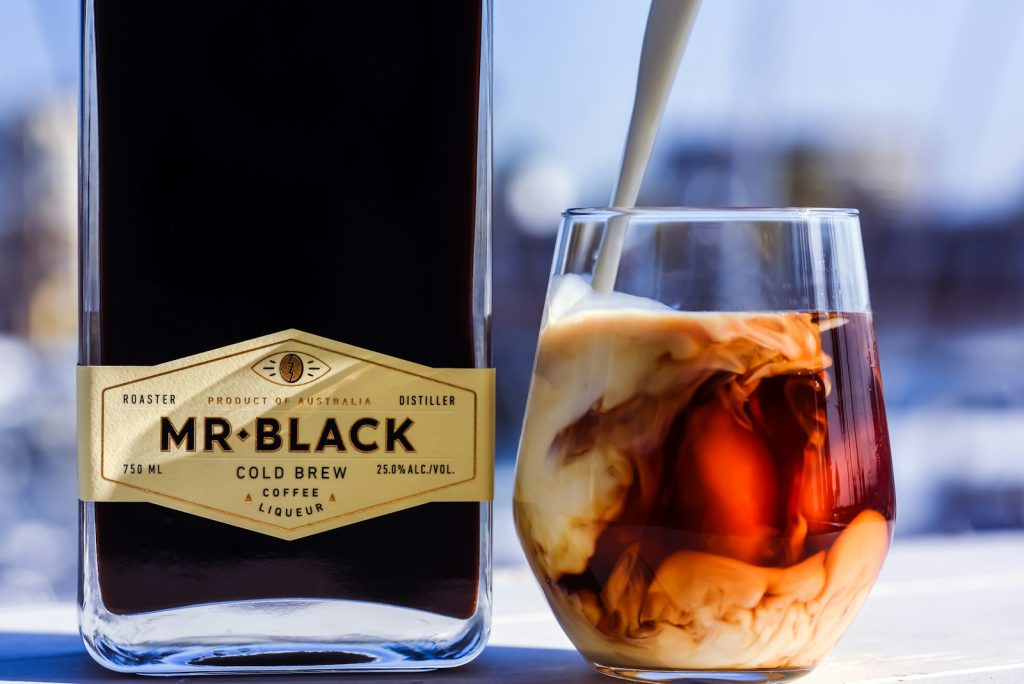
To make coffee liqueur, dissolve 1 cup sugar in 2 cups hot strong coffee, cool it, then add 1 cup of vodka or rum and a split vanilla bean. Rest it in a cool, dark place for about two weeks, strain, bottle and refrigerate. No authority we found sets a shelf life for homemade liqueur, so watch for spoilage.
Safety: keep the bottle in the fridge, and add cream or milk in the glass, never in the bottle. Throw the whole batch out if it fizzes, grows mold, turns slimy or smells sour (the full list is below), and store it where children cannot reach it.
Table of Contents
Coffee liqueur recipe
These are the proportions this page has always used. They are a taste choice, not a preservation calculation. No combination of coffee, sugar and spirit given here has been tested for shelf stability by anyone, and adjusting them changes the alcohol content of the result.
- 2 cups strong brewed coffee — a dark roast is the usual choice because the sugar will bury a delicate one
- 1 cup sugar (white for a clean sweetness, brown for molasses character)
- 1 cup vodka or rum — check the bottle’s ABV, because it sets the strength of everything you are about to make
- 1 split vanilla bean, or vanilla extract to taste
- Stir the sugar into the hot coffee until it has completely dissolved.
- Let it cool to room temperature before the alcohol goes in. Adding spirit to hot liquid boils off part of what you paid for.
- Add the spirit and the vanilla, stir, and pour into a clean glass jar.
- Rest it somewhere cool and dark, or in the fridge if you would rather not leave it out; we have tested neither. About two weeks is the conventional infusion time; this is a flavor judgment you make by tasting, not a process with a finish line.
- Strain through a fine sieve or a paper filter, bottle, label with the date, refrigerate.
Spices — a cinnamon stick, a few cloves, cocoa, hazelnut — go in during the rest and come out at straining. Honey or agave can replace the sugar; they will make it cloudier.
Why is my coffee liqueur cloudy, too sweet or too bitter?
It is cloudy. That is fine coffee sediment, not a fault. Strain again through a paper coffee filter and let it drip rather than squeezing it — squeezing pushes the fines through. Our comparison of paper, metal and cloth filters covers which one holds back the smallest particles.
It is too sweet, or too bitter. Both are the same problem: the sugar and the coffee are fighting. Bitterness usually means over-extracted coffee going in, so brew the base coffee properly rather than trying to rescue it with more sugar afterwards. Sweetness can only be diluted, and diluting with more coffee or more water lowers the alcohol content further — which brings you back to the alcohol arithmetic below.
How long does homemade coffee liqueur last?
We could not find a food-preservation authority that publishes a shelf life for homemade coffee liqueur, so this page does not print one. Instead it explains why the number is unknowable in a home kitchen, and gives you something better than a date: refrigerate it, and know what spoilage looks like.
Alcohol preserves things, but only above a concentration your bottle probably does not reach — and the concentration is the one thing this recipe never tells you.
Do the arithmetic on the recipe above. It mixes roughly 2 parts brewed coffee and 1 part sugar with 1 part spirit. Look at your bottle: most vodka sold in the US is 40% alcohol by volume. One cup of it carries about 0.4 cups of actual ethanol — and that ends up spread through roughly three and a half cups of finished liqueur once the coffee and the dissolved sugar are in there. That puts the result near 11% alcohol by volume: table-wine strength, not spirit strength. That is arithmetic on the recipe’s own proportions plus an estimate of how much volume the dissolved sugar adds — it is not a measurement — and it is as close as you can get, because you cannot measure the alcohol content of a sugar-loaded mixture with a hydrometer. A hydrometer reads density, and dissolved sugar pushes density up while alcohol pushes it down; in a sweetened liqueur the two effects sit on top of each other and the reading tells you nothing useful.
So: a sugary, water-based, low-alcohol liquid of unknown strength, made in a non-sterile kitchen, stored in a jar you sealed yourself. That is not a spirit. It is a perishable drink that happens to contain some alcohol, and it should be treated like one. Change the proportions — more coffee, less vodka, extra sugar — and you have changed the alcohol content again, in a direction you cannot read off any instrument you own.
How to store homemade coffee liqueur
- Keep it in the refrigerator once it is bottled, not in a cupboard. Cold does not sterilize anything, but it slows down whatever is in there.
- Make small batches. A bottle you will finish in a few weeks does not need a shelf life; a gallon jar you open twice a year does.
- Label the jar with the date you made it and what went into it. Future you will not remember whether that was the vodka batch or the rum one, or whether the extra sugar went in.
- Use clean, dry bottles and do not pour tasted liquid back into the jar. Every reintroduction is a fresh inoculation.
- If you add cream or milk — and cream is the obvious thing to add to coffee liqueur — you no longer have a shelf-stable anything. Add dairy in the glass at serving time, not in the bottle.
How to tell if coffee liqueur has gone bad
Pour a little into a clear glass in good light before you serve any of it. Discard the batch — the whole batch, not the affected part — if you see or smell any of the following:
- Fizz, bubbles, or a hiss or pressure release when you open the bottle. A sweetened liquid that starts producing gas is fermenting, and you did not put yeast in it on purpose. This one also matters mechanically: a sealed glass bottle around an active ferment is a pressure vessel. Our page on coffee wine covers why that failure mode is worse than it sounds.
- Any mold — fuzzy spots, a film, or a skin on the surface, at the neck, or under the cap.
- Ropiness or slime: liquid that pours thick or trails strands.
- A sour, yeasty, vinegary or “off” smell that was not there when you bottled it. Coffee liqueur should smell of coffee and alcohol.
- A haze or sediment that appeared later. Cloudiness straight after straining is just fine coffee particles — that is the filtering problem, above. Cloudiness that develops in a clear bottle weeks later is not.
This looks and smells like a coffee drink and tastes sweet. Store it where children cannot reach it and never leave it out in an unmarked jar.
Homemade vs store-bought coffee liqueur
The real difference is not the flavor, it is that a commercial coffee liqueur is made to a fixed formulation and prints its alcohol content on the label, and yours does not. A commercial producer knows the strength of what it has bottled and can state a storage instruction on the label; you do not, which is the whole reason yours goes in the refrigerator. When a cocktail recipe calls for a measure of coffee liqueur, it is assuming the commercial strength — so a White Russian built with a homemade bottle will be weaker than the one the recipe intends.
Scope and sourcing. This page is not food-safety guidance from a public health authority, and it does not certify any recipe as safe. We could not find any extension service, food-preservation authority or regulator that publishes a shelf life for homemade coffee liqueur, which is exactly why this page refuses to print one. The one hazard here that is documented — sealing glass around a liquid that is still fermenting — is covered on our coffee wine page, which cites the University of Georgia Extension’s home winemaking circular. For anything you intend to keep, give away or bottle, ask your local agricultural extension service or food safety authority rather than a coffee blog. Nothing on this page was made, bottled or tasted by us.
Corrections to earlier versions of this page
- An earlier version gave two shelf lives with no source for either: “lasts up to a year” in the body and “for up to six months” in its FAQ. This page gives none.
- An earlier version did not say to store the liqueur out of children’s reach.