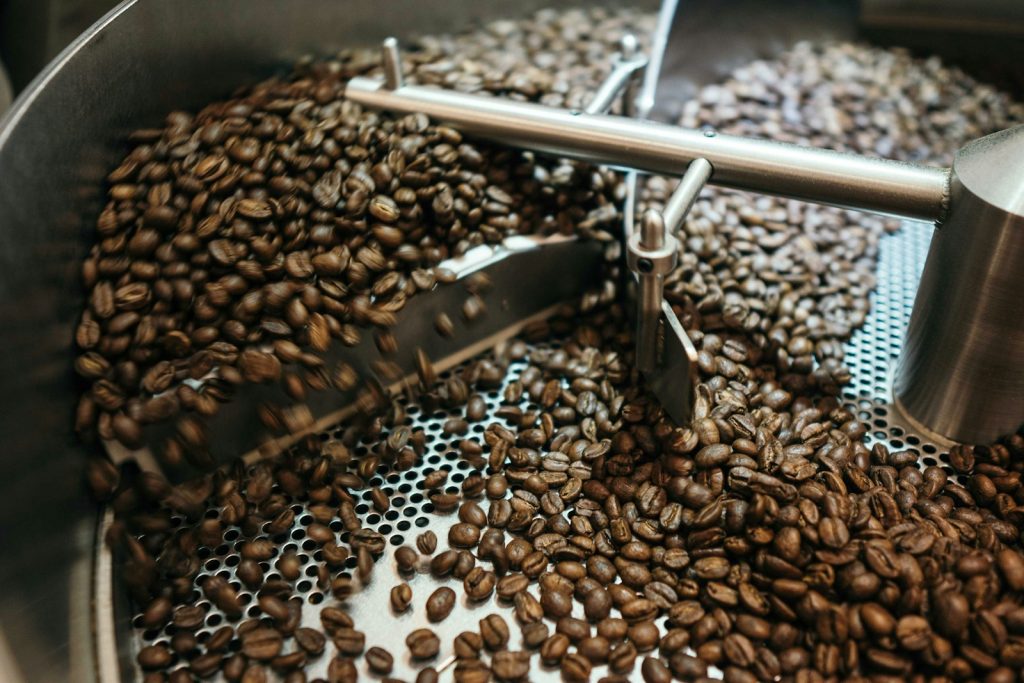
Roasting coffee at home means heating green beans to first crack or past it, stopping before they burn, and cooling them fast. Two hazards need managing: chaff, the dry papery skin that can ignite, and smoke, which Hottop’s manual says “can be a respiratory irritant”. Use a dedicated roaster, vent the smoke outside, and never leave a roast unattended.
Safety: chaff is the fire risk. It is dry, light, airborne and it burns. The manufacturer of the Hottop home roaster puts it at the front of its owner’s manual: the machine “has the potential to ignite flammable materials on, in, or near the roaster” and “can be operated in such a way as to create a fire hazard by igniting the beans being roasted and/or the chaff (a by-product of the roasting process)” (Hottop KN-8828B-2K / KN-8828P-2K Owner’s Manual, PDF). Both hazards are managed with ventilation, a clear space, and not walking away.
Know when to stop. Hottop’s manual: “If you start to see a lot of oil on the beans during the roast, if the sounds of second crack begin to slow after peak activity, or if the smoke begins to dramatically increase, immediately end the roast”. It calls these “warning signs that the coffee is reaching a dangerous point”: “If you allow the roast to go much further it could burn the beans in the roaster or the beans can even catch fire!” It adds that “when second crack ceases the beans are on the edge of being ruined and are approaching the ignition point”. It also tells owners to “Always use the indicated amount of beans (250 grams)”, Hottop’s figure for its own machine, because over-roasting “is more likely to happen when using less than the recommended amount of beans (250 grams)”.
Table of Contents
Chaff: what it is and why it is the fire risk
Sonofresco’s commercial roaster manual describes the mechanism plainly: “the bean will expand and increase in size during the roasting process. During this expansion phase the bean will ‘crack’ and shed it’s ‘skin’ also known as chaff (the outer skin of the coffee bean)” (Sonofresco Coffee Roaster CR1S User’s Manual, PDF). Chaff separates from the bean at first crack, weighs almost nothing, and moves with the air.
Both purpose-built roasters quoted here are designed around catching it. Sonofresco’s machine has a chaff collector with a fine mesh screen, and its manual warns that “SOME UNUSUAL CONDITIONS, SUCH AS NOT CLEANING THE CHAFF COLLECTOR AFTER EACH ROAST, DRASTICALLY OVERFILLING THE ROAST CHAMBER, OR BLOCKING THE ROASTER VENT, CAN CAUSE A FIRE IN THE ROASTING CHAMBER.” Hottop’s machine has a chaff tray with a safety switch that will not let the roaster run until the tray has been emptied, and its manual says:
For all models, empty the chaff tray after every roasted batch. The chaff and coffee bits in the chaff tray will become very hot during roasting. Chaff can ignite during the roasting process and may smolder in the chaff tray. Use great care when disposing of the chaff as it can create a fire hazard, particularly if it is dumped onto other flammable material soon after a roast has concluded.
Note what that means for a pan or an oven. An open pan on a hob and a baking tray in an oven have no chaff containment at all: the chaff lifts off the beans and lands wherever the air takes it — onto a gas flame, an electric element, the oven floor, or the worktop. This is an inference from the manufacturer documents above rather than a warning any of them wrote about pans, and we are flagging it as an inference. But the roasters that were engineered for this job all contain the chaff and all warn about it igniting, and that is the strongest signal available about what happens when nothing contains it.
Two further points from Hottop that apply to any method: over-roasted beans can catch fire, “particularly when the beans are ejected and become exposed to the atmosphere”, and the manual instructs owners to “Always have a spray bottle filled with water on hand when roasting to quench a fire if the beans ignite upon ejection.” Its emergency instructions, verbatim: “Do not attempt to move the machine if the ejected beans ignite. In the case of ignition, disconnect the machine, use the water-filled spray bottle or fire extinguisher to extinguish the flames, and call emergency services.”
Smoke, ventilation, and the people in the room
Some smoke is normal, and Hottop says it does not mean anything is wrong with the machine: “Smoke is a normal by-product of coffee roasting, so don’t worry … Smoke production will increase as the temperature of the coffee beans rises. Darker roasts create more smoke than lighter roasts.” A dramatic increase in smoke is different: see “Know when to stop” above. What else it says:
Coffee roasting produces smoke which can be a respiratory irritant. Control the smoke so it does not enter the structure. Take care if there are children or elderly in the home or if anyone in the home has respiratory or breathing problems. Avoid breathing the smoke. We recommend that you use the Coffee Roaster in a place where ample ventilation is available- in the kitchen under an efficient range hood which vents outside, or near a window with an exhaust fan.
“Vents outside” is the operative phrase. A recirculating cooker hood with a charcoal filter moves the smoke around the kitchen; it does not remove it. Sonofresco is stricter still for its gas model — “THIS IS A GAS FIRED APPLIANCE AND MUST NOT BE VENTED INTO A CLOSED SPACE” and “The roaster must be vented to the outside when used indoors to prevent the accumulation of emissions within the dwelling.”
The short safety list
- Never leave a roast unattended. Hottop: “Never leave the Coffee Roaster unattended while in operation!” — repeated at the head of every roasting procedure in the manual. Sonofresco: “Do not leave the roaster to run completely unattended.”
- Keep a clear space around the equipment. Hottop: “Always leave at least eight inches of space around the Coffee Roaster on all sides for proper ventilation when operating and until it has cooled. Keep the machine away from flammable materials such as curtains, towels, walls, furniture, or any other materials Place on a heat-resistant surface when in use.”
- Have a way to put out a fire before you start. A water spray bottle and an extinguisher, per the Hottop instruction quoted above, and a working smoke alarm in the room.
- Empty and cool the chaff before you throw it away. Not into a bin with paper in it, and not straight after a roast.
- Let the beans cool before they go anywhere. Sonofresco warns that cutting the power mid-roast stops the cooling cycle, and that beans left hot “can begin to smolder and generate smoke. Always allow the roasted beans to cool before removing from the roaster.”
- Do not roast this dark on purpose. Hottop: “Roasting coffee too dark should be avoided. Just like you can over-cook and burn food on your stove or in your oven, it is possible to over-roast and burn coffee.”
- Decaf is a special case, in both directions. Hottop: “Extra care must be taken when roasting decaffeinated coffee. The decaffeination process changes the indicators used to judge roast level and over-roasting can result.” Sonofresco adds a useful physical fact: “Decaffeinated coffees, which have no chaff, should roast fine in the roaster.” How decaf is made is on our decaf coffee beans page.
How a home roast goes, by sound
Roasters navigate by sound and colour, not by a number on a dial. The beans go from green to yellow to brown while shedding moisture; first crack is a sharp snapping as steam ruptures the bean, and it marks the start of the drinkable range; the chaff comes off around here. Keep going and the beans darken, the smoke thickens and second crack arrives — finer and faster than the first — as the bean’s structure breaks down and oil migrates to the surface. That surface oil is why dark roasts look shiny, and it is covered at why some coffee beans are oily.
Hottop’s manual gives the sequence in sound. “First crack sounds somewhat like breaking wooden pencils: distinct, easily heard, sharp snaps.” “After first crack ends there is usually a period of about one or two minutes before second crack begins”, and second crack is “a more muffled, subtle sound than first crack”. For a coffee that is new to you, it advises: “start with a mid-level roast level”. Those are one maker’s instructions for its own machine; follow your roaster’s manual where it differs.
Where you stop between those two events is the roast level. What each level does to the cup — acidity, bitterness, how much of the origin survives, and the caffeine question — is set out with its sources on coffee roast levels, and is not repeated here. The one thing worth carrying over is the NCA’s warning that the names are not standardised: “one roaster’s dark coffee may be different than another’s”. When you roast your own, you are the only definition that matters.
Equipment, in order of how much trouble it saves you
- A dedicated roaster (drum or fluid-bed) contains the chaff, controls the airflow, cools the beans at the end, and Hottop’s manual describes a chaff-tray safety switch that “will not allow the operation of the roaster unless the chaff tray has been emptied after a roast.” It does not do everything: venting, supervision, clearance and fire-fighting stay your job. That containment is the reason to buy one, more than roast quality.
- A hot-air popcorn popper is the traditional cheap route and it does move the chaff out of the roasting chamber — into the room. Use it outdoors or under a hood that vents outside, and be aware you are running an appliance outside its intended use, which is your risk and not the manufacturer’s.
- A pan or an oven gives you the least control over the two things this page is about: the chaff and the smoke. Both are workable outdoors on a side burner. Indoors they are the versions of home roasting most likely to end with a smoke alarm, which makes them the wrong place for a beginner to start.
- A metal colander and something to stir with for cooling, plus heat-resistant gloves. Cooling fast is not optional — it is what stops the roast.
None of this equipment has been bought, used or tested by anyone at this site, and no brand here is a recommendation. The two manuals quoted throughout were chosen because they are manufacturers’ own documentation and are freely readable, not because we own the machines.
Cooling, resting and storing
Get the beans out of the heat and cool them fast — a metal colander and stirring, or two colanders poured back and forth. Then leave them alone for a couple of days. The trade body says that after roasting and cooling, beans are ready “after resting for about 2 to 3 days”, and “Ideally, you should ground and brew your coffee beans about 2 to 7 days after roasting to enjoy the freshly roasted flavor at its peak” (NCA, Roasts). Give it those two days before you judge the roast.
After that, the NCA’s storage guidance is to protect the beans “from air, moisture, heat, and light (aka their greatest enemies)”, to use an opaque airtight container, and to keep it out of cabinets near the oven or dishwasher. Its shelf-life table gives roasted whole beans at room temperature 1–3 weeks and ground coffee 1–2 weeks (NCA, Storage and shelf life). Roast in batches you will drink inside that window; the main advantage of roasting at home is freshness, and a big batch throws it away.
When you brew it, the dose and temperature are the same as for any other coffee: 55 g of coffee per 1 kg of water for filter brewing, and 90–96 °C water, with the sourcing on our best temperature for French press coffee page.
Buying green coffee
Green coffee keeps far better than roasted — the NCA notes that “green coffee beans can be stored for long periods of time without losing quality or taste” — so this is the one part of the supply chain where buying ahead is sensible. Beyond that, the advice is thin: buy a small quantity of two or three different origins from a seller who states the harvest year, roast them the same way, and find out what you like. Descriptions of what a Colombian or an Ethiopian coffee “tastes like” in the abstract are describing a country, not a lot, and this site has cupped none of them. Our origin pages, such as South American coffee beans, cover what is genuinely regional.
Sonofresco’s own caveat is worth repeating for anyone buying cheap: “not all green coffees are equal. While most green coffee will roast well in your roaster, some poorly processed coffees may not.”
Disclaimer: This page is general information, not a substitute for the manual that came with your equipment. Follow your own roaster’s or appliance’s instructions, which take precedence over anything here. The smoke guidance is quoted from a manufacturer and is not medical advice; if anyone in the household has a respiratory condition, treat roasting smoke as you would any other cooking smoke and ask their clinician.
Corrections to earlier versions of this page
1. A pan temperature range. The old step-by-step said “Preheat: Start by heating your pan or roaster to about 400°F” and “Monitor Temperature: Keep the temperature between 350-450°F during most of the roast.” No source, and the number is doing something misleading as well as being unsourced: in a pan, the surface temperature of the metal, the air above it and the inside of the bean are three different things, and a thermometer in a pan is measuring whichever one it happens to be touching. The only sourced temperature statement we can offer is the NCA’s, and it is deliberately loose — beans are “rapidly brought to a very high internal temperature (over 400 degrees Fahrenheit), then quickly cooled” (NCA, Roasts).
2. A per-variety roast temperature table. It gave “Recommended Temperature Range (°C)” of 200–210 for Arabica, 225–230 for Robusta, 185–195 for Ethiopian and 210–220 for Colombian. Beyond having no source, that table contradicts itself: Ethiopian and Colombian coffees are overwhelmingly arabica, so three of its four rows are describing the same species at three different temperatures. It has been deleted rather than corrected.
3. Equipment prices. A table gave “$50-$500” for a roaster, “$10-$30” for a thermometer and so on. Nobody here priced anything, prices move, and there is no year attached. Gone. The same goes for the old comparison table’s claims about how many minutes each method takes and how consistent it is — those were presented as measurements and were not.
Also corrected: an earlier version said only “Choose a well-ventilated spot because roasting creates a lot of smoke.” and never mentioned chaff; it told beginners to start with a pan or an oven; it said to “let the flavors settle and mature for about 24 hours before brewing”, where the NCA says about 2 to 3 days; it carried an FAQ block whose answers are now in the text; and it said both machines quoted here will not restart until the chaff tray is emptied, which we found only in Hottop’s manual.