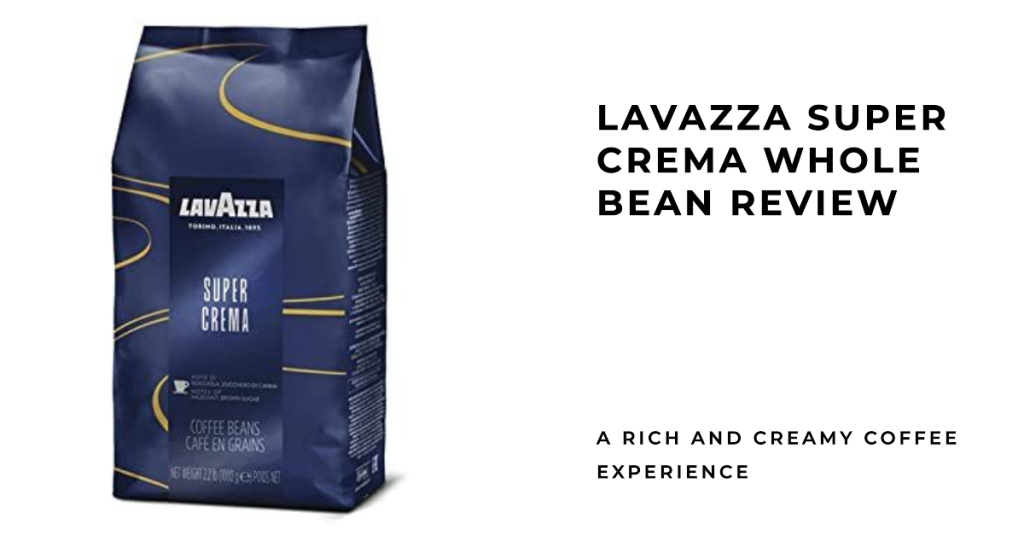
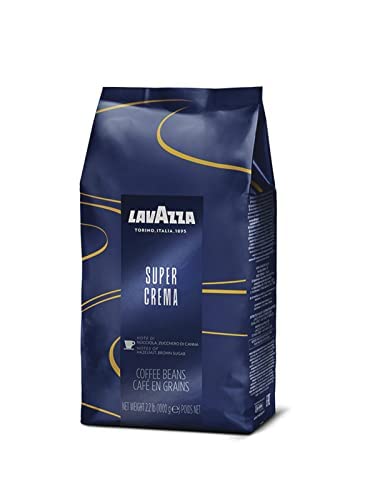
Nobody at this site has brewed, tasted or measured Lavazza Super Crema, so this page is a sourced summary of what Lavazza publishes, not a review. Lavazza’s US page describes Super Crema as an Arabica-and-Robusta espresso blend with “notes of roasted hazelnut and brown sugar”, and Lavazza publishes no percentage split between the two species anywhere we could find.
This page also lists the things the manufacturer does not tell you. If you want a verdict on how it pulls on your machine, this page cannot give you one, but it can stop you buying on the strength of specifications that were invented. This page covers the whole-bean Super Crema; for capsule and pod systems, including Lavazza’s A Modo Mio capsules, see our page on types of coffee pods.
Table of Contents
What Lavazza publishes
| Specification | Lavazza USA (whole bean) | Lavazza international (business, 1 kg beans) |
|---|---|---|
| Blend | Arabica and Robusta — no percentage given | Arabica and Robusta — no percentage given |
| Origin | Asia, South America | Central America |
| Roast | Medium | Medium light |
| Character | Aromatic, medium body | “Traditional Italian espresso with rich cream” |
| Aroma notes | Roasted hazelnut and brown sugar; “nutty” | Honey, nutty |
| Sizes | 10.5 oz, 22 oz, 2.2 lb | 1 kg |
The disagreement between Lavazza’s own two pages is worth sitting with. A blend at this scale is bought on the world market and reformulated to hit a flavour target, so the origin field on a marketing page is a snapshot, not a recipe. That is also why no honest page can tell you what is in the bag on the shelf in front of you: only the bag can.
The one specification that is stable across both listings is the useful one: this is a blend that includes Coffea canephora, sold as Robusta, alongside Arabica. That is the standard Italian espresso construction and it is what produces the heavy, persistent crema the product is named for. If you want the background on why blenders do this, see our pages on Arabica coffee beans and Robusta coffee beans.
What is not known
- The species split. Not published.
- Roast date. Lavazza’s product listings do not publish one, so how long ago any particular bag was roasted is not knowable before you have it in your hands.
- How it tastes to you. No published specification predicts that, and no page that has not brewed it can tell you.
- How it compares with other espresso blends. The previous version of this page ranked it against Starbucks Espresso Roast and Illy Classico with a price column of dollar signs and no measurements behind any of it. That comparison has been deleted, not corrected.
If you want this tested properly
A real test of an espresso blend is short and repeatable. Anyone with a scale reading to 0.1 g and a timer can run it, and if this page is ever updated with first-hand results, this is the protocol they will have come from:
- Record the machine and grinder by model, and the roast or best-before date from the bag.
- Record the dry dose in grams to 0.1 g, and the grind setting as a number on that grinder.
- Record the shot time in seconds from pump start, and the wet yield in grams — not in millilitres, because crema falsifies volume.
- Repeat three times at the same setting before changing anything, and report all three.
- Record what was paid, where and on what date, so the value claim has a basis.
Until those numbers exist, this page will keep saying it has not tasted the coffee.
Where to buy it
Affiliate disclosure: the link below is a paid link. As an Amazon Associate I earn from qualifying purchases. The price you pay is unchanged. This is not a recommendation and not a tested endorsement — we have not tried this coffee, and the link is here because the page is about this specific product.
Lavazza Super Crema whole bean, 2.2 lb, on Amazon
Before you buy any bag of espresso beans, check the roast level against what your machine and palate want — our page on coffee roast levels covers what “medium” does and does not commit a roaster to, and it is one of the specifications on which Lavazza’s own two listings for this product disagree.
Corrections to earlier versions of this page
The 2023 version of this page was written in the first person as though the site had lived with the coffee. It said the blend “has been a staple in our morning routine”, asked “Our favourite part?”, and reported that “we found the blend to be a bit too mild for our liking”. It did all of that while containing no machine, no dose, no grind setting, no shot time, no yield and no price — the six things any real espresso test produces first.
That was a fabricated endorsement. The US Federal Trade Commission is blunt about this in its endorsement guidance: “You can’t talk about your experience with a product if you haven’t tried it.” Every first-person experience claim has been removed from this page, and none of it has been replaced with a differently-worded version of the same thing.
Four specific claims were also wrong or unsupported:
- “60% Arabica and 40% Robusta.” We could not find Lavazza publishing any percentage for Super Crema, on its US site or its international business site. The figure has been removed and deliberately not replaced with a different number.
- “Origin: Brazil, India, Colombia, Indonesia”, with the Arabica assigned to the first three and the Robusta to Indonesia. Lavazza’s own listings do not say this. Its US product page gives the origin as “Asia, South America”; its international business listing for the 1 kg bean bag gives “Central America”. Those two are not the same, which is a good reason not to state bean-by-bean origins for a commodity espresso blend at all.
- A pros list saying “long shelf life due to nitrogen packing” beside a cons list saying “packaging may not be airtight”. Those two statements contradict each other inside the same box, and neither was sourced. Both are gone.
- “Approximately 140 shots of espresso… less than 20 cents per shot.” A per-shot cost cannot be derived without a price, and the page never gave one. Removed.